The best part of my day. It is when I play with a child. For children, play isn’t just fun—it’s the foundation for how you grow, learn, and develop. For decades, research has shown that play is essential. It’s how you build creativity, problem-solving, and social and emotional skills.
But sometimes, adults can overlook the importance of play. Young kids are often expected to sit still at a desk, be quiet, and pay attention all day. We believe there’s a better choice.
This list of meaningful quotes is here to inspire everyone—teachers, parents, and kids—to make play a bigger part of everyday life. These quotes serve as a reminder of how vital play is for your happiness, growth, and well-being. Let’s celebrate the critical time for structured and unstructured play that helps you develop all the life skills you need!
This collection is far more than inspiration. With the wisdom of pioneers and the foundation of researchers, these quotes are dedicated to understanding childhood. Every quote here contains context for why these words carry weight.
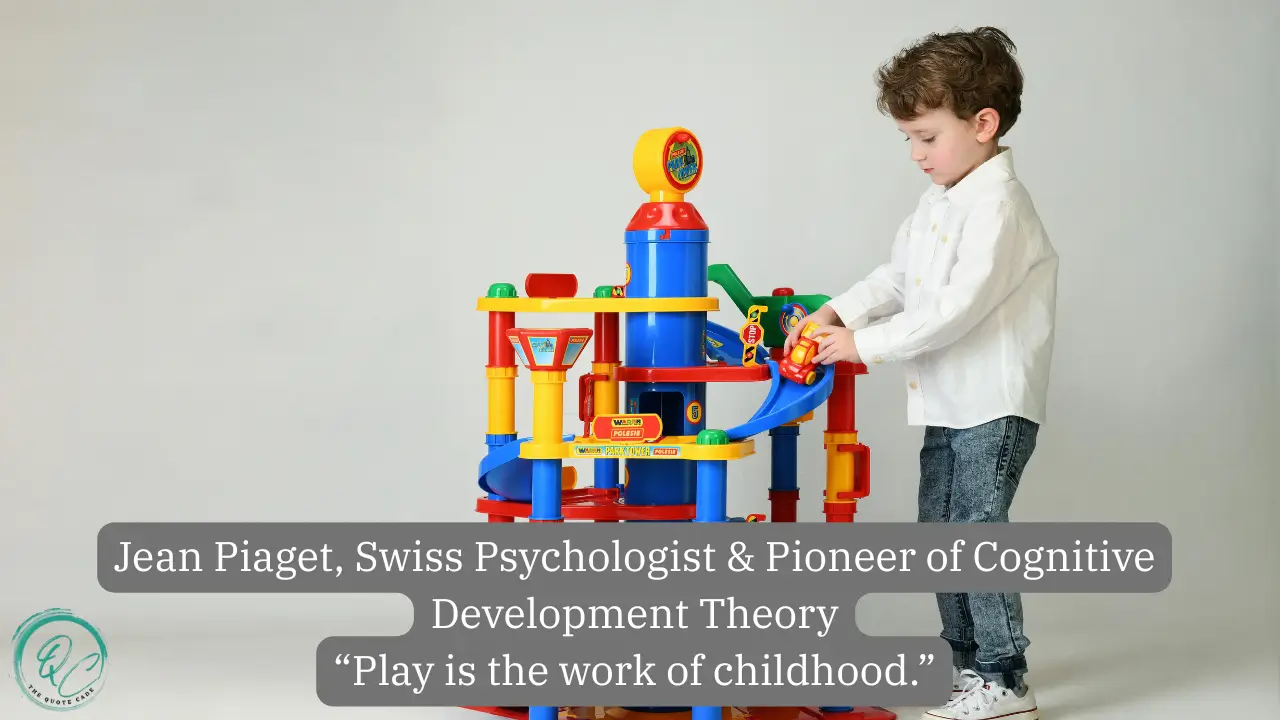
Jean Piaget, Swiss Psychologist & Pioneer of Cognitive Development Theory “Play is the work of childhood.” Why it matters: Piaget taught us that children aren’t just small adults; they learn and understand the world through distinct stages. Play is the essential “work” that drives this cognitive development, allowing them to experiment, discover, and construct knowledge.
Maria Montessori, Physician & Founder of the Montessori Method “Play is the child’s most useful tool for preparing for the future and adapting to the present.” Why it matters: Montessori revolutionized education by observing that children learn best through self-directed activity in a prepared environment. This quote underscores her view of play as practical, purposeful, and central to building life skills and adaptation.
Fred Rogers, Television Host, Educator & Child Advocate “Play is often talked about as if it were a relief from serious learning. But for children, play is serious learning.” Why it matters: With gentle authority, Mr. Rogers corrected a major cultural misconception. He reminds adults that for children, the social, emotional, and intellectual growth happening in play is the core curriculum.
Lev Vygotsky, Psychologist & Founder of Cultural-Historical Psychology “In play, a child is always above his average age, above his daily behavior; in play, it is as though he were a head taller than himself.” Why it matters: Vygotsky’s theory highlights the “zone of proximal development”—what a child can do with guidance. Play, especially pretend play, creates this zone naturally, allowing children to stretch beyond their current developmental level and practice more advanced skills.
David Elkind, Child Psychologist & Author of The Hurried Child “Play is not a luxury but rather a crucial dynamic of healthy physical, intellectual, and social-emotional development at all age levels.” Why it matters: In an era of academic pressure and overscheduling, Elkind’s work is a critical defense of unstructured play. He frames it not as optional fun but as a critical biological and psychological imperative for well-being.
Ruth Wilson, Ph.D., Early Childhood Education Specialist & Author “Children need the freedom and time to play. Play is not a luxury. Play is a necessity.” Why it matters: This concise, powerful statement from a dedicated environmental educator cuts to the core. It serves as a direct, quotable mantra for parents and teachers advocating for the time and space children need.
Penelope Leach, Child Psychologist & Author of Your Baby & Child “Playing is not a break from learning. It is endless, delightful, deep, engaging, and practical learning. It’s the doorway to the child’s heart.” Why it matters: Leach connects the cognitive development to the emotional heart of the matter. Her words remind us that effective learning is joyful and that play is the pathway to a child’s inner world, building happiness and connection.
Mr. Fred Rogers (Revisited for Depth) “For children, play is serious learning. Play is really the work of childhood.” Why it matters: This combination of his two most famous insights reinforces the theme with gentle repetition. It’s a cornerstone quote for advocates, perfectly merging the concepts of joy and purpose in a child’s development.
Vivian Gussin Paley, Kindergarten Teacher & Author of You Can’t Say You Can’t Play “Play is the place where a child’s most important thinking is done. In play, children invent the world for themselves.” Why it matters: Paley, from decades of classroom experience, observed that the narratives and rules children create during play are complex exercises in logic, ethics, and problem-solving. This quote highlights play as the original workshop for abstract thought.
Erik Erikson, Developmental Psychologist & Psychoanalyst “The playing child advances to new stages of mastery.” Why it matters: Erikson’s theory of psychosocial development outlines key “crises” a child must resolve. He saw play as the primary arena where children safely experiment with and develop the skills and confidence needed to master each stage, from initiative to industry.
Stuart Brown, M.D., Founder of The National Institute for Play “Play is the gateway to vitality. By its nature, it is uniquely and intrinsically rewarding.” Why it matters: Brown brings a biological and neurological perspective. His research shows that play lights up the brain and is fundamental not just to learning but to overall well-being and adaptability throughout life. This frames play as a health imperative.
Magda Gerber, Early Childhood Educator & Founder of RIE® “Be careful what you teach. It might interfere with what they are learning.” Why it matters: While not a direct “play” quote, this wisdom from the respectful care philosophy is critical for understanding unstructured play. It reminds adults to overlook the urge to constantly direct and instead trust the child’s innate curiosity and self-guided development during play.
Alfie Kohn, Author & Lecturer on Human Behavior & Education “Children learn how to make decisions by making decisions, not by following directions. And play is the primary way they get to make decisions.” Why it matters: Kohn, a critic of traditional reward/punishment systems, champions autonomy. This quote powerfully links play to the development of executive function, creativity, and intrinsic motivation—the core life skills needed for adulthood.
Brené Brown, Ph.D., Research Professor & Author “Play is an essential nutrient for the human spirit. It’s as vital as sleep or food.” Why it matters: Brown’s work on vulnerability and wholehearted living brings the conversation to emotional and social resilience. By calling play a “nutrient,” she gives it a non-negotiable status in the recipe for happiness and connection, appealing powerfully to a modern adult audience.
Celebrating the joy of a little one? Discover touching
quotes for baby boy
that express love, happiness, and the beauty of parenthood.
2. Inspiring Quotes About Play: Short, Sweet & Shareable
Long paragraphs are not always needed; a line is enough. This collection is not about words; it captures the pure joy of play in a few words. These quotes are so powerful that they will add a spark to your social feed.
“Play is the highest form of research.” – Often attributed to Albert Einstein. 💬 Share this Quote
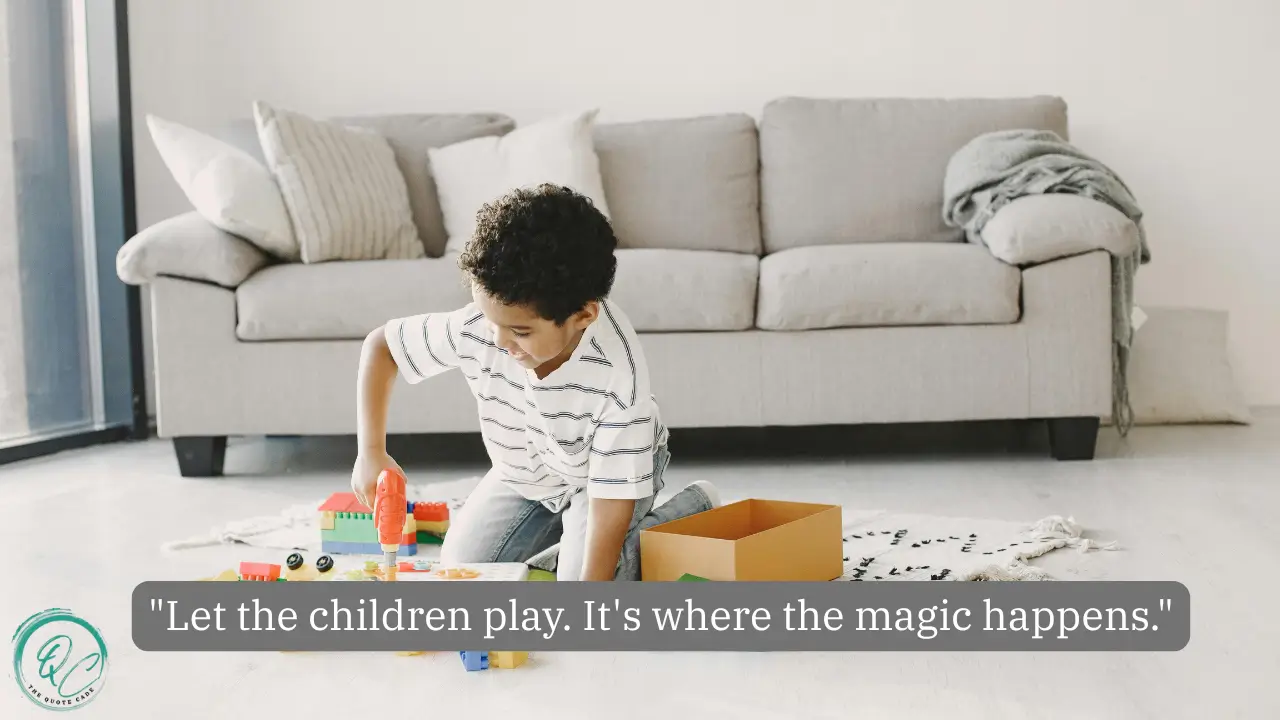
“Let the children play. It’s where the magic happens.”
“The creation of something new is not accomplished by the intellect but by the play instinct.” – Carl Jung.
“Play is the exhalation of childhood.”
“Children see magic because they look for it.”
“A child’s play is their most sincere language.”
“In every real child, there is a hidden well of play.”💬 Share this Quote
“Play is the answer to how anything new comes about.” – Jean Piaget
“The playing mind is a learning mind.”
“Work without play makes for a very dull childhood.”
“Adults follow paths. Children explore.”💬 Share this Quote
“Play is the fertilizer for growing imaginations.”
“You can discover more about a person in an hour of play than in a year of conversation.” – Plato.
“Happiness is a child lost in play.”
“Play builds the architecture of the brain.”
“Don’t just teach your children to read. Teach them to love running through a field, chasing butterflies, and getting gloriously muddy.”💬 Share this Quote
“Play is the shortest route between children and their happiness.”
“The world is a playground. Know it. Play in it.”
“Play is the universal language of childhood.”
“A child’s life is like a piece of paper on which every person leaves a mark. Let yours be a fingerprint of play.”💬 Share this Quote
“Play today for a smarter, kinder, more creative tomorrow.”
“The best classrooms and homes have roofs called ‘sky’ and floors called ‘grass’.”
“Play is the spark that lights the fire of curiosity.”
“When you play, you are practicing the art of being human.”
Love these? Pin your favorites to your inspiration board!
3. Some More Amazing Play Quotes: For the Advocate
We know play is vital, but sometimes words are needed to explain the action. These quotes are advocating the essential conditions for growth, resilience, and learning.
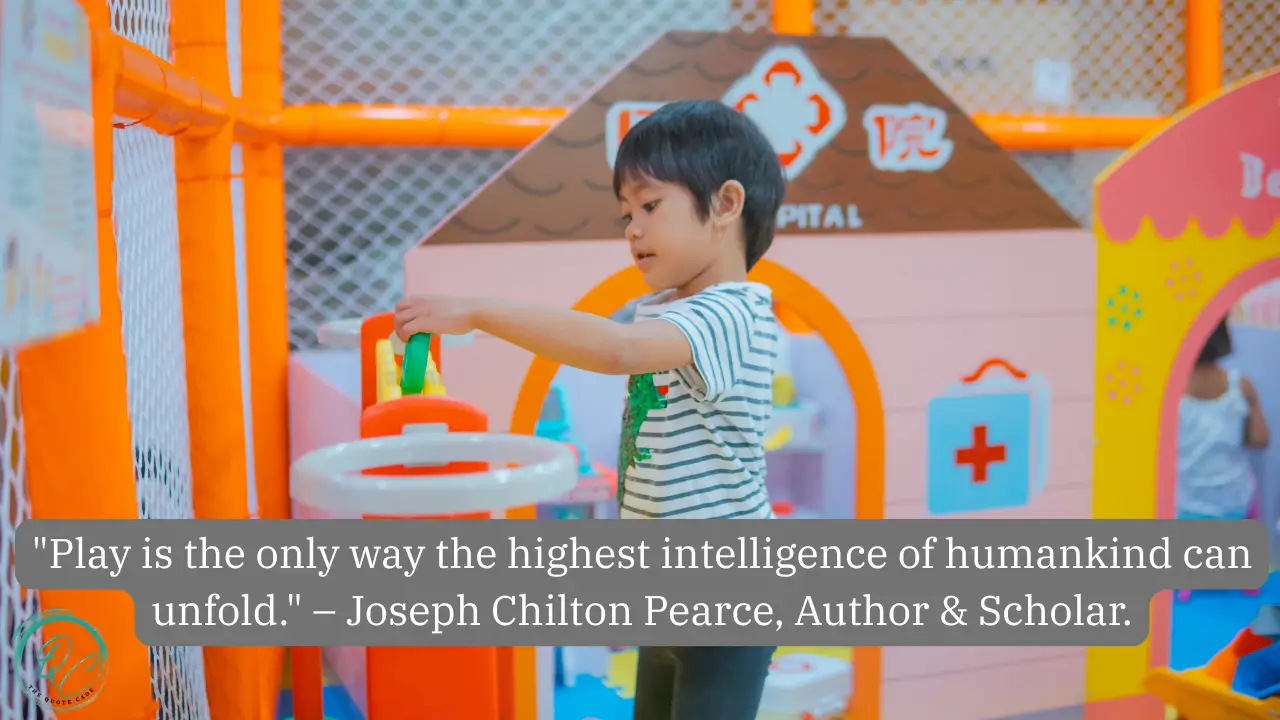
“Play is the only way the highest intelligence of humankind can unfold.” – Joseph Chilton Pearce, Author & Scholar. Use this to say: Play isn’t childish; it’s the pinnacle of human cognitive development.
“The opposite of play is not work. It’s depression.” – Dr. Stuart Brown, Founder of The National Institute for Play. Use this to say: Removing play isn’t creating discipline; it’s risking mental and emotional health.
“We are never more fully alive, more completely ourselves, or more deeply engrossed in anything than when we are playing.” – Charles Schaefer, Ph.D., Founder of The Association for Play Therapy. Use this to say: Play isn’t an extra activity; it’s a state of peak engagement and selfhood for a child.
“”Play is the brain’s favorite way of learning.” – Diane Ackerman, Author & Naturalist. Use this to say: This makes the biological case. Play isn’t less effective than direct instruction; it’s the brain’s preferred and most efficient method.
“Cutting playtime to make room for more academics is like taking the foundation out from under a house to make room for more rooms.” – Inspired by countless child development experts. Use this to say: A powerful analogy for administrators. You cannot build higher-order skills without this foundational support.
“The most effective kind of education is that a child should play amongst lovely things.” – Plato. Use this to say: Even ancient philosophers understood this. It’s not a modern, permissive idea but a timeless truth about human learning.
“Play gives children a chance to practice what they are learning. They have to play with what they know to be true to find out more.” – Mr. Fred Rogers. Use this to say: Play is the necessary practice field where academic concepts become integrated, understood, and useful.
“It is a happy talent to know how to play. Protecting that talent is our job as adults.” – Inspired by the work of psychologists. Use this to say: Play is a critical talent to nurture, not a habit to break. Our role is to be guardians of this ability.
“Children need the freedom to appreciate the infinite resources of their hands, their eyes, and their ears, the resources of forms, materials, sounds, and colors.” – Loris Malaguzzi, Founder of the Reggio Emilia Approach. Use this to say: Unstructured play with open-ended materials isn’t empty time; it’s the essential process of discovering the world’s richness and one’s own creative capacity.
“Do not keep children to their studies by compulsion but by play.” –Plato Use this to say: Forcing learning creates resistance. Playful engagement creates lifelong learners. This is about efficacy, not just fun.
“When we deny children play, we are denying them the right to understand the world.” – Adapted from Jan White, Nature Play Specialist.t Use this to say: This frames the denial of play as a profound deprivation of a basic right to comprehend life.
“Play builds the kind of free-and-easy, try-it-out, do-it-yourself character that our future needs.” –James L. Hymes, Jr., Child Development Expert. Use this to say: This connects play directly to future success. The “soft skills” of innovation, resilience, and initiative are born in play.
Want to celebrate bonding moments with your little one? Discover heartwarming
playtime with baby quotes
that capture love, laughter, and the beauty of growing together.
4. Happy Playing Kids Quotes Short
Sometimes wisdom comes in a precise package. The following are the favorite and powerful quotes that you will surely like to save and share. They will give you a quick inspiration.
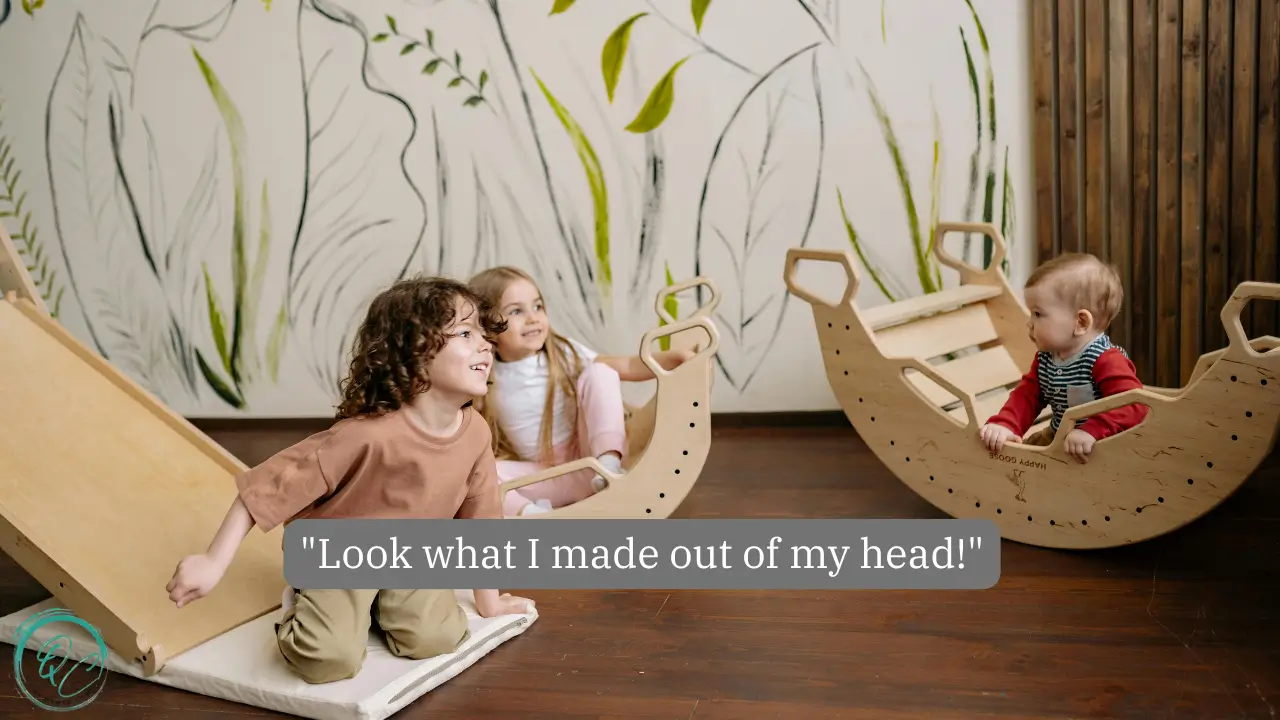
“Look what I made out of my head!” A celebration of self-directed creation and imagination.
“I’m not just building a tower. I’m building the tallest tower in the history of ever.” The boundless ambition and grand narrative are found in simple block play.
“Let’s pretend this blanket is a magic boat to dinosaur land!” The incredible transportive power of imagination and symbolic play.
“When I play princess, I get to solve all the problems.” Play as a safe space to practice agency, leadership, and problem-solving.
“I’m just figuring it out with my hands.” A child’s profound understanding of tactile, experiential learning.
“My favorite color to play with is all of them.” The joyful, unrestricted embrace of possibility.
“Playing is how I find out how the world works.” A direct quote that perfectly defines play as scientific research.
“I was playing, and then the idea just popped into my play-brain!” Insight into the unique, creative state of the “play-brain.”
“My teddy bear told me the secret today, but it’s only for when we’re playing.” The sacred confidentiality and rich inner world created in solitary or companion play.
“I’m fixing the clock with my imagination wrench.” A beautiful example of how play seamlessly blends reality with inventive problem-solving tools.
“I dance when I’m happy, and playing makes me dance on the inside.” On the intrinsic, physical joy that play generates, linking emotional state to movement.
“The best castles are built with friends and a little bit of arguing.” An honest take on the social negotiation and collaborative engineering inherent in group play.
“I can play with a cloud by just looking at it and thinking it into a story.” The ultimate proof that play requires no toy—just a mind free to imagine and narrate.
“This box isn’t empty. It’s full of ‘what if?'” A perfect metaphor for open-ended play, where the potential is limitless.
“Shhh, my blocks are sleeping so they can dream up a new building for tomorrow.” The tender, animistic relationship a child builds with their playthings, seeing life and possibility in everything.
“I’m the boss of the red light, and the green light is my friend who says ‘GO!'” Play is the arena for understanding rules, power dynamics, and social roles in a safe, controlled way.
From Inspiration to Action: Your Play Toolkit
These quotes are more than just words—they’re starting points. Here’s how to turn this inspiration into real-world play and connection.
How to Use These Quotes?
In Your Space: Frame a printed quote for your playroom or classroom wall as a daily reminder of play’s value.
In Communication: Use one as a positive sign-off in a newsletter to parents or a note to your child’s teacher.
As a Journal Prompt: Write a quote at the top of a page and let your child draw the story that comes to mind.
Conclusion
As per my experience, playing is a child’s most honest dialogue. It has fundamental importance in daily moments. Its impact on activities is way more than a way to pass the time. It helps in emotional development and building lifelong well-being. The connection formed during these games is what shapes a child throughout his life.
FAQ’s: (Frequently Ask Questions)!
Q1. What is the quote for child play?
A classic quote is by Fred Rogers: “Play is often talked about as if it were a relief from serious learning. But for children, play is serious learning.” It perfectly captures how essential play is for development.
Q2. What are the best quotes about happy kids?
A wonderful one is by Carl Jung: “The creation of something new is not accomplished by the intellect but by the play instinct.” This links a child’s innate playful happiness directly to creativity and innovation.
Q3. Had fun with kids’ quotes?
Absolutely! Exploring these quotes is a joyful reminder of childhood’s magic. They reframe our adult perspective, helping us rediscover the profound wisdom and pure happiness found in simple, playful moments.
Q4. What is the best quote for Happy Children’s Day?
For Children’s Day, consider: “Every child is a different kind of flower, and all together make this world a beautiful garden.” It’s a vibrant, inclusive quote celebrating the unique happiness each child brings.
Q5. What is a small positive quote for kids?
A small, powerful quote for kids is: “You are braver than you believe, stronger than you seem, and smarter than you think.” (A.A. Milne). It’s a direct boost to a child’s confidence and self-worth.