I have often been in arguments with a friend or a stranger. Who leaves me completely riled up. When a perfect comeback comes to my mind after the fighting is over. A French term, l’esprit de l’escalier, describes the great comebacks that come up only after the fact.
Best retorts taste as sweet as revenge when used at the right time. Crafting witty replies on the spot is hard. That’s why I have curated a list of the best comebacks to shut someone up. They help to come up with good comebacks to use in the heat of verbal battle.
Next time you find yourself arguing with a bully and wish you had spoken. I guarantee these snarky comebacks will wipe the smirk right off your enemy’s face. The best part? You will walk away feeling victorious.
Keep your strategy in place; the following comebacks are aligned with a goal. Remember, a prompt reply will change everything.
To DEFLECT (Avoid the Drama)
“Noted.” (The king of unbothered. Simple, dismissive, and ends the thread.)
“I’ll let you have that opinion.” (A graceful way to say “agree to disagree” without a fight.)
“This doesn’t seem productive. Let’s pause.” (The professional deflector for work or family.)
“Okay.” (The one-word wall. Acknowledges them without agreeing or continuing.)
“If you say so.” (A verbal shrug that shows you’re unconvinced and uninvested.)
To DISARM (Neutralize with Wit)
“I’m sure you didn’t mean that.” (Gives them an “out” while highlighting the rudeness.)
“Are you okay?” (Expresses “concern” that subtly calls out their irrational tone.)
“Thanks for the feedback!” (A cheerful way to dismiss unsolicited criticism.)
“That’s certainly one way to look at it.” (A polite, backhanded way to say their view is strange.)
“I’d agree with you, but then we’d both be wrong.” (A classic, witty reversal that shuts down bad logic.)
To DEFINE (Set a Firm Boundary)
“I don’t accept being spoken to that way.” (A clear, non-negotiable statement of your standard.)
“This conversation is over.” (The direct, unambiguous close. Requires no further reply.)
“Let’s keep this professional.” (The essential boundary-setter for work chats.)
“I’m not debating this.” (Shuts down an argument firmly and finally.)
“I’m going to end this discussion here.” (You take control and declare the end, calmly and conclusively.)
Remember: The most powerful part of any comeback is the strategic pause before you send it. Ask: “Does this text achieve my goal?”
2. Funny Comebacks to Shut Someone Up
Not an angry reply is important everywhere; only a smile or a serious reply in a funny tone is enough. This lets you call out the behavior without losing your dignity. Based on real-world scenarios, your laugh can be the most cutting reply.
15 Funny Comebacks (With a Straight Face)
“Your opinion has been registered and filed under ‘Wildly Irrelevant.'”
“I’d explain why you’re wrong, but I left my crayons at home.”
“It must be exhausting to be this wrong all the time.”
“I’ve been forwarded to my ‘Not Gonna Engage’ department.”
“Ah, you’ve confused this meeting with one where your input is needed.”
“I admire your confidence in sharing that thought with the group.”
“Let’s bookmark this idea and never, ever reopen it.”
“Is there a point, or are you just practicing your monologue?”
“I’ll add that to the list of things I didn’t ask for.”
“Fascinating. Truly. Now, about the actual topic…”
“I appreciate you demonstrating exactly what not to do.”
“That’s a bold strategy. Let’s see how it works out for you.”
“I’m choosing to believe you’re doing a bit right now.”
“You seem to have mistaken my patience for interest.”
“Noted, with the enthusiasm it deserves.”
For Specific High-Stakes Scenarios
In a Group Chat: “I admire your confidence in sharing that with everyone.” (Publicly highlights their audacity while staying classy.)
To a Manipulative Ex: “Ah, the classic [Ex’s Name] rewrite of history. The director’s cut is always so creative.” (Uses humor to expose their gaslighting without getting emotional.)
To a Credit-Stealing Coworker (over email): “Thanks for compiling the team’s thoughts! I’ve attached the original timeline of my contributions for the record.” (A “polite” reply that subtly corrects the record for all to see, using their own email against them.)
Want to add humor to your romantic conversations? Check out
flirty jokes to make him laugh
for playful and charming lines that bring a smile.
3. Comebacks to Shut Someone Up
The most effective argument doesn’t mean louder words but an exact statement that is impossible to ignore. You may not win the argument, but clearly close the discussion.
The Direct Terminators
“This exchange is terminated.”
“Consider this matter closed.”
“I am ending this dialogue now.”
“Full stop.”
The Boundary Enforcers
“You have reached the limit of my engagement on this.”
“My participation in this conversation is now complete.”
“You no longer have an audience for this.”
“I am revoking my attention from this topic.”
The Professional Closers
“This channel is now closed for this subject.”
“I am archiving this discussion.”
“We have reached the endpoint.”
The Unassailable Exits
“My final position has been transmitted.”
“No further correspondence will be entered into.”
“This is my last communication on this issue.”
“The floor is hereby closed.”
4. Comebacks to Say When Someone Says Shut Up
When someone tells you to “shut up,” it’s a raw power play meant to silence you. The perfect reply isn’t just a retort—it’s a reassertion of your right to speak, recalibrating the power dynamic on the spot. Here are 15 strategic responses tailored for real-world authority and impact.
In the moment of “shut up,” when you feel a power to silence you. These comebacks area reassertion of your right to speak. These comebacks are strategic responses crafted for the real world for power and influence.
15 Authority-Reclaiming Comebacks
The Calm & Controlled (Professional/Public Settings)
“I’ll finish my point, and then you can have the floor.” (Asserts your right to speak without denying theirs.)
“I don’t speak to people who use that tone. We can try again respectfully.” (Sets an immediate behavioral boundary.)
“I believe we were having a discussion, not a shutdown contest.” (Reframes their aggression as childish, elevating your position.)
“My voice isn’t optional here.” (A simple, powerful statement of your inherent right to contribute.)
The Witty & Deflective (Social/Familiar Settings)
“Make me.” (A classic, confident challenge that calls their bluff. Use with a steady tone, not anger.)
“I will, just as soon as you say something worth listening to.” (Shifts the focus to the lack of value in their speech.)
“No, thank you.” (Polite, dismissive, and brilliantly unbothered. Ignores the command and treats it as an offer.)
“You first.” (A quick, mirroring retort that turns their command back on them.)
The Direct & Unflinching (When a Line is Crossed)
“You don’t get to silence me.” (A clear, non-negotiable declaration of your autonomy.)
“That is not an acceptable way to speak to me.” (Names the transgression and states your standard.)
“I wasn’t finished. Do not interrupt me.” (A direct command that re-establishes the conversational order.)
The Thought-Provoking & Strategic
“What’s the real reason you don’t want to hear this?” (Bypasses the fight to question their motive, often disarming.)
“I can see this topic makes you uncomfortable. Should we pause?” (Frames their aggression as emotional discomfort, taking the high road.)
“I hear your frustration, but my perspective stands.” (Validates emotion without ceding your position—a masterful blend.)
“Noted. And disregarded.” (The ultimate power move. Acknowledges they spoke while rendering their words irrelevant.)
How to Choose & Use Them?
For a superior or colleague: Use #1, #2, #3, or #4. They are professional, uphold your dignity, and are unlikely to be cited as “unprofessional” in a formal setting.
For a friend or sibling in a heated argument: Use #5, #6, #7, or #8. They use humor or deflection to break the tension without escalating into a more personal fight.
For a disrespectful stranger or a serious boundary violation: Use #9, #10, or #11. They are clear, firm, and designed to halt the behavior immediately.
For a manipulative partner or relative: Use #12, #13, or #14. They avoid the trap of a shouting match and instead expose the underlying dynamic, putting the emotional labor back on them.
The key to delivery is composure. Say your chosen line slowly, with steady eye contact and calm posture. Then, stop talking. The power lies in the statement itself and the confident silence that follows.
5. Sarcastic Comebacks to Shut Someone Up
Sarcasm is the scalpel of comebacks—precise, sharp, and designed to make a point by saying the opposite of what you mean. Its power lies not in volume, but in tone and timing. These 15 comebacks are crafted to deliver that cutting, memorable answer
15 Sarcastic Scalpels
“Oh, brilliant insight. You should write a book on the obvious.” (For painfully unoriginal or redundant criticisms.)
“Wow, you solved it. The Nobel committee is on line one.” (For unsolicited, simplistic advice on a complex problem.)
“Don’t stop now, this is the most fascinating monologue I’ve ever ignored.” (For someone who loves the sound of their own voice, especially in meetings.)
“I’m genuinely amazed. It’s rare to meet someone so confidently wrong.” (For incorrect statements delivered with unwavering arrogance.)
“Thanks for the permission. I was just waiting for your go-ahead.” (For micromanagers or those who grant unsolicited approval.)
“Is that your final answer? I’d hate for you to strain yourself.” (For half-baked, lazy contributions to a discussion.)
“Tell me more about how I should run my life. I’m taking notes.” (For intrusive, patronizing life advice.)
“Bravo. That performance almost deserved an audience.” (For dramatic overreactions or manufactured outrage.)
“I’m so glad you’re here to explain my own job to me.” (For condescending “explanations” from someone less informed.)
“You’re right. The world does revolve around your opinion.” (For self-centered interruptions or derailments.)
“What a unique and special perspective… said no one, ever.” (For clichéd, generic, or wildly unpopular takes.)
“Please, continue. I was just thinking I needed a lesson in the irrelevant.” (For off-topic rants that waste everyone’s time.)
“Fascinating. Did you come up with all by yourself?” (For parroted talking points or unoriginal insults.)
“I’d love to lower myself to your level, but I don’t have a ladder.” (A classic reframe that positions their behavior as beneath you.)
“Not all heroes wear capes. Some just offer breathtakingly bad takes.” (For someone who wrongly thinks they’re “saving” the conversation.)
6. Savage Comebacks to Shut Someone Up
Savage comebacks are not just about going to finish someone but with an equally controlled destruction. A conversion with no confusion, with extreme prejudice when you are ready to burn the bridge.
The Dismissive Annihilations
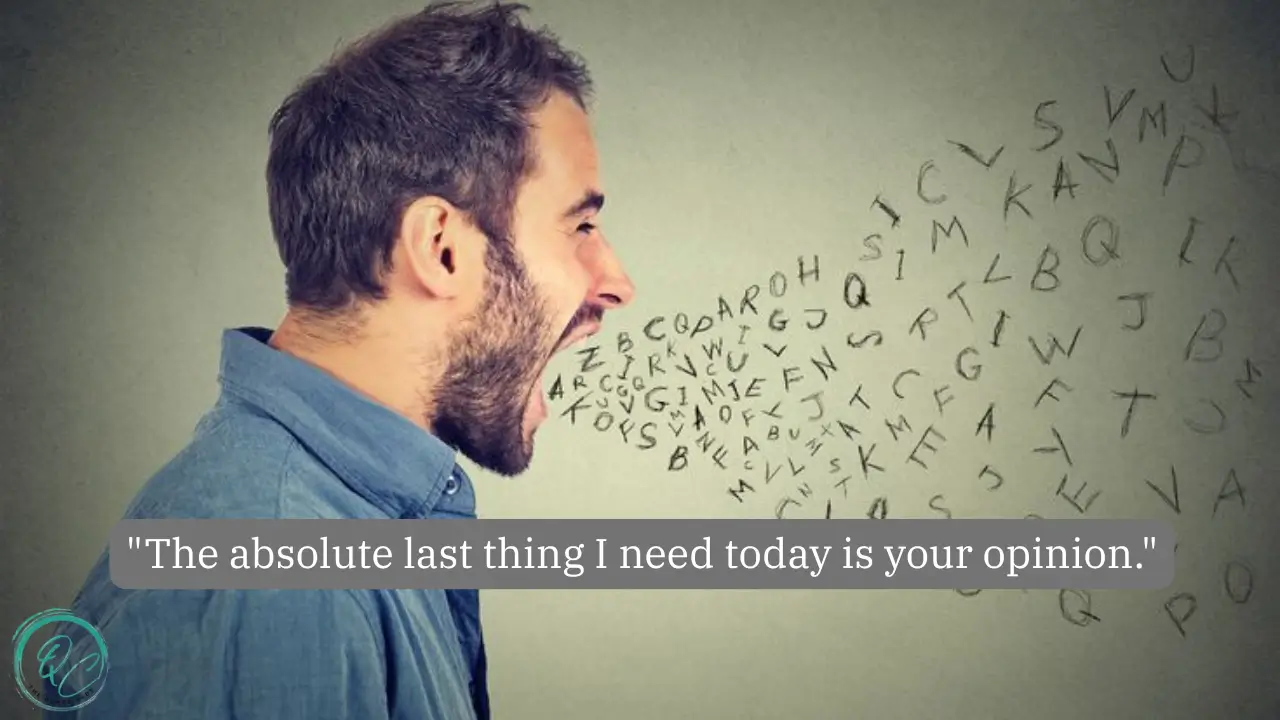
“The absolute last thing I need today is your opinion.”
“I don’t have the time, or the crayons, to explain this to you.”
“Is there a point to this, or are you just practicing being irrelevant?”
“Your validation isn’t required for my reality.”
“Save your breath. You’ll need it to blow up your next delusion.”
The Brutal Truth-Tellers
“We both know you’re not speaking to inform, you’re speaking to exist. Stop it.”
“The only thing more exhausting than your argument is your effort to have one.”
“You have the right to remain silent. It would be an improvement.”
“I’d agree with you, but then we’d both be stupid, and I’m not.”
“Your mouth is moving, but all I hear is the dial-up tone of an empty mind.”
The Unforgettable Exits
“This conversation is a cul-de-sac, and I’m not circling back.”
“I’m leaving now. Try not to say anything else while I’m gone.”
“We’re done. If you continue, you’re just talking to yourself.”
“I’ve allocated all the energy for you I’m willing to waste. The account is closed.”
“Stop. You’ve reached the end of my interest in you.”
Conclusion
The best comebacks to shut someone up start with a crucial mindset shift. It’s not about steering the conversation after an insult into a humorous one. But a perfect roast depends on clever timing and delivery of a witty and relevant retort.
This needs real effort and practice. A good guide never gives lines to shuffle but helps to understand with practice.
FAQs About Best Comebacks
Q1. How do you clap back at haters?
Deploy a strategic, emotionless comeback. Use witty deflection, a boundary-setting statement, or complete silence. Your calm response disarms their aggression and shows their words hold no power over you.
Q2. What can I say to make someone shut up?
Use a definitive, conversation-ending statement. “This discussion is over,” “I don’t accept that tone,” or “Noted.” Deliver it calmly and follow with unbroken silence to enforce the boundary you just set.
Q3. How do you respond to being told to shut up?
Reclaim your authority without shouting. Calmly state, “I’ll finish my point,” or “You don’t get to silence me.” This asserts your right to speak and exposes their attempt as a powerless demand.
Q4. How do you give it back to rude people?
Match their energy strategically, not emotionally. A sharply witty or coldly factual response highlights their rudeness while you stay composed. The goal is to reflect their behavior, not join it.
Q5. How to shut down disrespect?
Immediately name the behavior and state a consequence. Say, “That was disrespectful. If it continues, this conversation ends.” This establishes a firm boundary and places the choice to escalate on them.