The Marine Corps have their own culture of lore and mystique. With time, through battles and feats of the men and women earning titles of United States Marines. The reason behind their unshaken discipline, intensity, and relentless desire.
The motivational marine quotes in this article are more than phrases. A compiled list of top timeless Marine quotes. We invite you to scroll through your favorite quotes. Feel the spark that has driven Marines for years.
Boost you inpiration with the courage and sacrifice of the man of steel.
A. Quotes About Courage and Strength
These are not just words for grand gestures. True courage lives in the quiet choices we make daily, and real strength is often forged in moments no one else sees. The following quotes are crafted to honor that subtle, resilient core within every human experience.
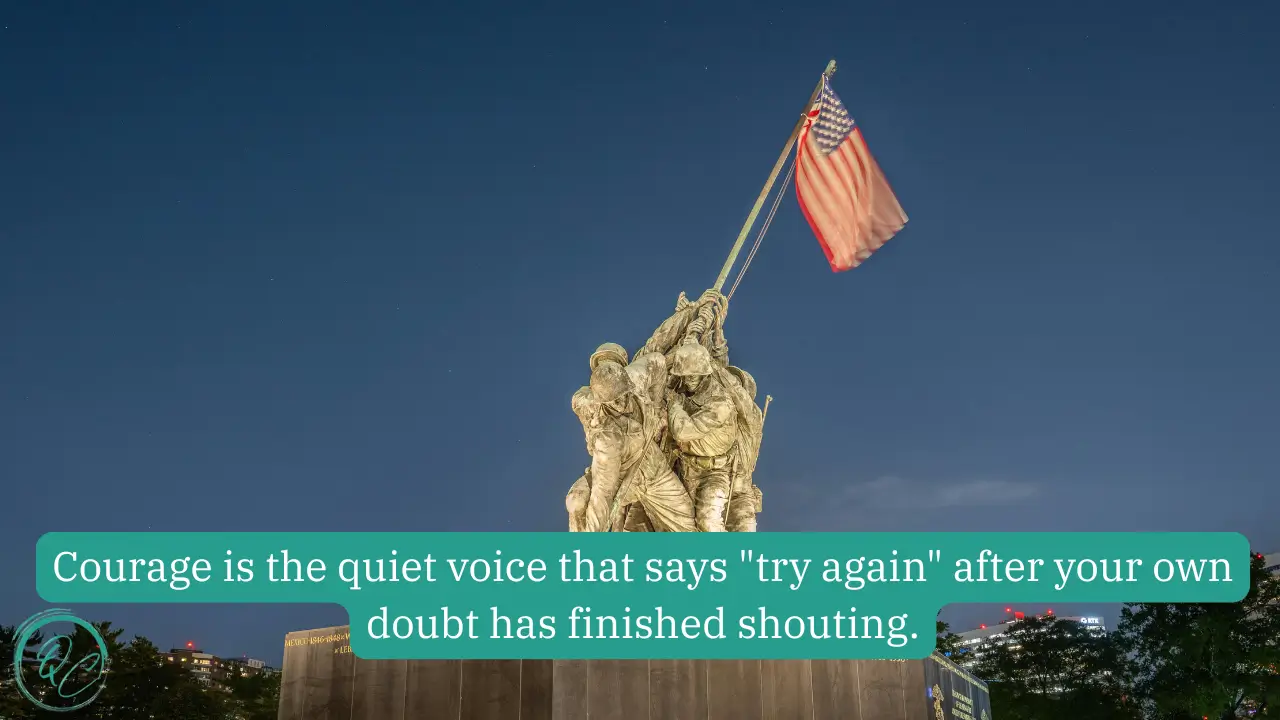
Courage is the quiet voice that says “try again” after your own doubt has finished shouting. True bravery isn’t the absence of fear or self-doubt, but the decision to act despite their loud, convincing arguments. It’s a gentle, persistent inner resolve.
Strength isn’t the wall that never cracks. It’s the careful hands that repair it, again and again. Resilience isn’t about being impervious to damage; it’s defined by our loving commitment to our own repair and the patience of our own restoration.
You don’t find courage in the light, waiting for the storm to pass. You build it in the dark, brick by brick, while the rain still falls. Bravery is an active construction project, not a passive waiting game. It is built through continued action amidst the difficulty itself.
Sometimes the strongest thing you can do is not tighten your grip, but to exhale and loosen it. Strength is often about release, not force. It takes immense power to let go of control, a toxic situation, or a version of yourself you’ve outgrown.
Your bravery is a personal history, written in the small decisions no one ever celebrated but you. The most profound acts of courage are often private—setting a boundary, speaking a quiet truth, getting up on a mundane, hard day. You are your own most important witness.
Fear visited me and said it would stay forever. I set a place for it at the table, and we began a difficult, necessary conversation. Courage isn’t about evicting fear. It’s about acknowledging its presence so thoroughly that you disarm it, learning its message without letting it dictate your life.
They see the mountain you climbed. I honor the weight of the stone you carried in your pocket long before the ascent began. True understanding honors the invisible burdens—grief, trauma, insecurity—that make every visible achievement so much more significant.
Strength grows in the awkward soil of ‘I don’t know,’ watered by the humility of ‘I need help.’ Real fortitude is rooted in vulnerability and the willingness to be a learner. It is supple, adaptable, and connected, not rigid and isolated.
Courage doesn’t always roar. Sometimes, it’s the simple refusal to narrate your own defeat before the chapter is over. Bravery can be a silent pact with yourself to withhold final judgment, to leave space for a plot twist, and to see the story through.
You are stronger at the broken places—not because the break vanished, but because you learned to channel the light through its new patterns. Our wounds and struggles don’t just “heal” to disappear; they transform us. Our strength comes from how we redirect our experience, allowing it to illuminate new paths.
The bravest people I know are not fearless. They are intimately acquainted with fear’s landscape, and they walk through it anyway to get to what they love. Courage is a form of navigation, not immunity. It uses fear as a map to identify what truly matters, making the journey purposeful.
Don’t confuse the callused hand with a closed heart. The deepest strength is often tender, protecting a softness it refuses to let the world harden. Endurance can be an act of love, a shield for one’s own compassion and sensitivity. The toughest exteriors often guard the most gentle spirits.
Your strength is not a battery to be depleted. It is a current you learn to connect to, a rhythm you discover by moving with your own truth. This reframes energy from a finite resource to a renewable flow. Strength is found in alignment and authenticity, not in grim depletion.
Courage is the small, stubborn flame you shield from the wind of other people’s opinions, so you can see your own path by its light. Bravery is often the act of protecting your own inner guidance system from external noise, trusting its flicker above all else.
The ground beneath your feet feels unbreakable, not because it never shook, but because you learned how to stand on shifting earth. That is your home territory now. Ultimate strength is built through adaptation to instability. Your competence and confidence come from knowing you can handle life’s tremors.
Sharing warm wishes this season? Explore heartfelt words that say
merry and bright days
to spread joy, kindness, and positivity.
B. Inspirational Marine Quotes About Life
The Marine Corps ethos isn’t just about combat; it’s a profound philosophy on perseverance, teamwork, and navigating adversity. These principles forge a unique perspective on life itself.
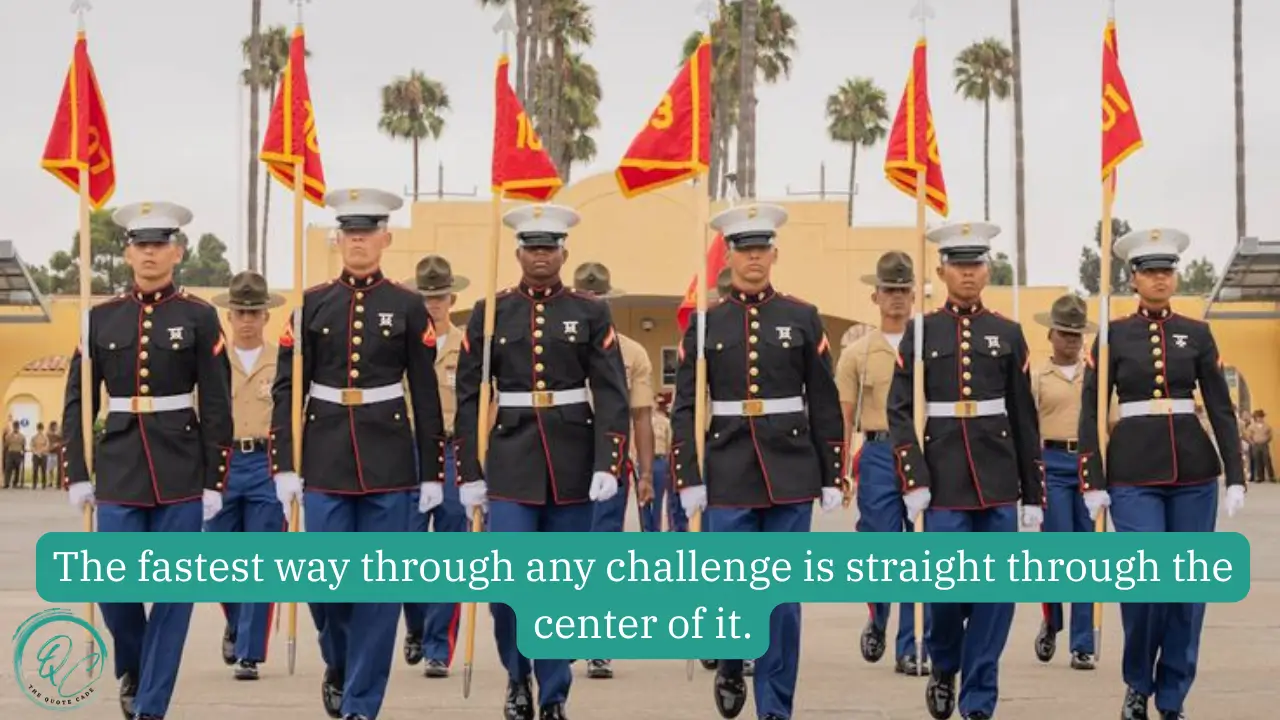
The fastest way through any challenge is straight through the center of it. Origins: Forged during endurance training, where recruits learn that circumventing an obstacle only prolongs exposure to misery. How Marines Use It: In training, this mindset is applied to everything from a long hike to a complex problem. It kills hesitation and builds the habit of direct, decisive action.
Don’t pray for lighter burdens. Pray for a stronger back. Origins: A sentiment shared in infantry units when missions intensify, focusing on internal capacity over external change. How Marines Use It: This reframes hardship during Crucible events and beyond. The focus shifts from complaining about the load to building the mental and physical fortitude to carry it.
Your team isn’t the people you fight alongside. They’re the people you refuse to fail. Origins: Born in the brotherhood of shared suffering in boot camp, where one person’s failure is seen as a collective responsibility. How Marines Use It: This defines the core of unit cohesion. It’s instilled in team-based drills where success is impossible without every member, creating an unbreakable bond of mutual accountability.
Peace is not the absence of conflict. It is the ability to maintain your clarity in the midst of it. Origins: Developed from combat leadership principles, where maintaining command and control under chaos is the ultimate goal. How Marines Use It: Trained through stressful, simulated combat exercises. The objective is to make calm decision-making under pressure a default setting, applicable to any crisis.
You own everything that happens to you, up to and including your last breath. Your response is your only sovereign territory. Origins: Rooted in the warrior’s code of absolute personal responsibility, regardless of circumstance. How Marines Use It: Drilled into recruits from day one. No excuses are accepted. This builds the foundational mindset that even when you can’t control an event, you always control your reaction to it.
The objective isn’t to get knocked down. The objective is to develop a faster, more efficient system for getting back up. Origins: Learned in the martial arts training of the Marine Corps Martial Arts Program (MCMAP), where recovery is as important as the attack. How Marines Use It: Applied in relentless physical and tactical drills. Failure is expected; the lesson is in the speed and resilience of the recovery, normalizing resilience.
Your comfort zone is a story you told yourself about your limits. We’re here to edit the ending. Origins: A drill instructor’s philosophy for pushing recruits past perceived physical and mental breaking points. How Marines Use It: This is the engine of transformation in boot camp. Every evolution is designed to prove to the individual that their “limit” was merely a suggestion.
True confidence isn’t believing you’re the strongest in the room. It’s knowing you’ve been trained to solve for the unknown. Origins: Stemming from the “Strategic Corporal” concept, where even junior Marines must make critical decisions with incomplete information. How Marines Use It: Cultivated through ambiguous scenario training. The goal is to build a mindset that welcomes the unknown because the decision-making framework is unwavering.
Adversity is a precision tool. It doesn’t just test you; it sculpts you. Pay attention to the shape it’s creating. Origins: A reflection shared after deployments or difficult training cycles, finding meaning in the hardship. How Marines Use It: Used in debriefs (After-Action Reviews) to transform difficult experiences into lessons. The focus is on growth: “What did this reveal, and what did it build in you?”
You don’t rise to the occasion. You sink to the level of your most ingrained training. So make your training brutal and your habits flawless. Origins: A core truth observed in high-stress combat situations, where fine motor skills and complex thought vanish, leaving only muscle memory and simple, drilled procedures. How Marines Use It: This justifies the extreme repetition and rigor of all training. The goal is to make the correct response so deeply ingrained that it emerges under any level of stress.
The tide doesn’t care about your plans. Build your foundation where the water is, not where you wish it would be. Origins: Adapted from amphibious operations philosophy, where flexibility and adapting to the actual environment are paramount. How Marines Use It: Applied in mission planning to counter rigid thinking. It teaches adaptability—assess the real situation, not the ideal one, and start making progress there.
Your uniform isn’t what you wear. It’s the standard you maintain when absolutely no one is watching. Origins: The essence of the “Honor” in the Corps’ core values, emphasizing that integrity is a private practice before it’s a public display. How Marines Use It: This is the bedrock of discipline. It’s the expectation that a Marine will do the right thing in the dark, building a trustworthy character, not just a compliant soldier.
One person can be a point of failure. Two people are a team. Three people are a system that can sustain a loss and keep moving. Origins: Derived from tactical fire team structure and the hard lessons of combat survivability. How Marines Use It: This governs how small units are built and trained. It emphasizes redundancy, mutual support, and designing systems (and relationships) that are resilient to shock.
The weapon is just a tool. The will is the projectile. Forge it first, and aim it always. Origins: A marksmanship instructor’s deeper lesson, separating technical skill from the decisive mental intent required to apply it. How Marines Use It: In training, equal time is spent on building the “warrior mindset” as on physical skill. Technique is useless without the unwavering will to act.
You are not the storm. You are the calm that forms in its eye. Find that center, and you can outlast anything. Origins: Inspired by the need for leaders to project calm during chaos, creating a focal point of stability for others. How Marines Use It: Trained in leadership courses. The most effective leaders are not the loudest, but those who can create an island of clear thought for their team in any crisis.
Sending a thoughtful message can make someone’s day better. Share kind words that gently say
hope your day goes well
and spread a little positivity.
C. Motivational Quotes for Marine Boot Camp
Boot Camp isn’t just a test; it’s a deliberate forge. These insights are born in the sweat, grit, and silent determination of the transformation from civilian to Marine.
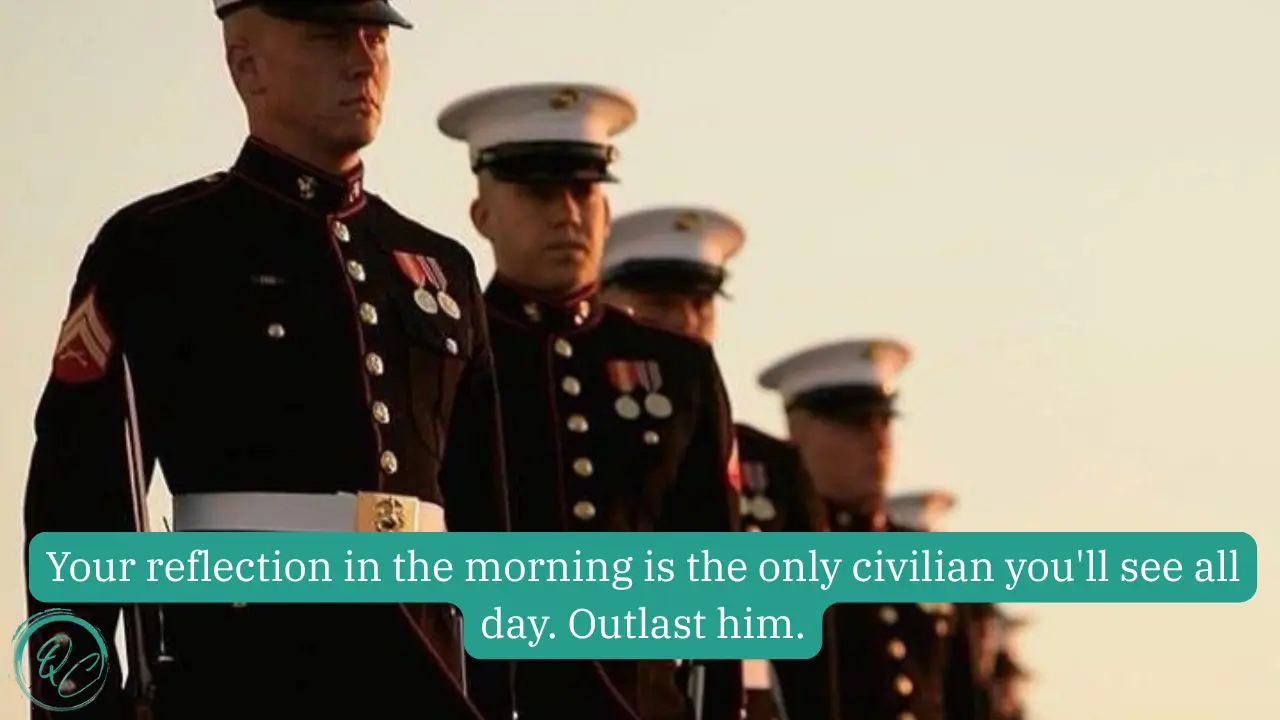
Your reflection in the morning is the only civilian you’ll see all day. Outlast him. A thought during first formation, looking at a weary face that still feels separate from the title “Marine.”
They aren’t just breaking you down. They’re dissolving the glue that held your old limitations together. Realization during the intense “forming” phase, reframing the hardship as a necessary deconstruction.
The fastest way to the end is to fully inhabit every grueling minute between now and then. Learned on the quarterdeck or during a long drill, understanding that wishing time away magnifies suffering.
Your drill instructor isn’t your enemy. Your doubt is. They’re just the loud, relentless ally forcing you to fight it. A pivotal shift in perspective during the third week, when the purpose of the pressure starts to become clear.
This isn’t about being the hardest. It’s about being the most adaptable. Let the routine shape you. The moment a recruit stops fighting the schedule and lets the discipline become a backbone.
The pain in your feet is a map. It’s charting every step of the distance between who you were and who you’ll be. A sustaining thought during long hikes, transforming physical agony into a measure of progress.
You are not one voice shouting into the storm. You are one note in a chord that can hold back the wind. Find the harmony. The first time the platoon moves or sings in perfect unison, feeling individual struggle become collective power.
You will be handed a standard impossible to meet. The victory is in the relentless reach, not the final grasp. Facing an immaculate uniform inspection or a perfect rifle score, understanding the pursuit is the point.
The fire watch is not a punishment. It’s your first silent command. Guard the peace of those who now trust you to. The solemn responsibility felt during the midnight watch, recognizing the earliest seed of true duty.
They give you the same gear as everyone else. What you build inside it—that will be your own unique weapon. Lacing up identical boots, understanding the journey is about forging the intangible within the uniform.
When your body screams to quit, your mind must issue a simple, one-word order: ‘Forward.’ The mental command used on the endurance course, reducing complex agony to a single, executable directive.
Look at the recruit to your left and right. Your finish line is not the same place without them crossing it too. The bedrock of brotherhood, cemented during team events where failure is collective and success shared.
You are not being filled with knowledge. You are being stripped of the luxury of hesitation. During immediate action drills, where a correct response must be instant and instinctual, not considered.
The ‘you’ that graduates was born in every moment you chose ‘again’ over ‘I can’t.’ The cumulative truth realized in the final week, seeing the new self built from thousands of small decisions.
They can issue you orders, clothing, and a title. Only you can issue yourself the permission to become a Marine. The ultimate internal shift, where external validation is replaced by an earned, internal certainty.
Life doesn’t always go as planned. Learn how
expecting disappointment
can help protect your peace of mind and stay grounded through setbacks.
D. Quotes About Marines from Enemy
The ultimate testament to a warrior’s reputation is not always found in the praise of allies, but sometimes in the wary respect of those who have faced them across the battlefield. These perspectives cut to the core of what makes the Marine Corps ethos so formidable.
They do not fight for a piece of land. They fight for the man beside them, which makes the land they stand on unconquerable. Repeated in squad bays after intelligence debriefs, reinforcing that their brotherhood is their ultimate tactical advantage.
You can defeat their position, but you cannot defeat their patience. They will simply become the silence that waits for you to celebrate. Studied in sniper and reconnaissance training as the highest form of psychological compliment to their discipline.
Other soldiers we fought. The Marines… we encountered. It was less a battle and more a force of nature to be survived. A stark point of pride is shared before major operations, embodying the shock and awe they aim to instill.
They do not retreat. They relocate their violence to a more advantageous time. Used in after-action reviews to reframe tactical withdrawals, emphasizing the enduring offensive mindset.
Their greatest weapon is not their rifle; it is a terrifying, shared belief that they are already victorious. Cited by officers to explain the importance of esprit de corps and cultivating an aura of inevitability.
You can see the fear in a young Marine’s eyes, but it is harnessed—a fuel, not a brake. That is what is unnerving. Discussed in leadership courses to validate that courage is not the absence of fear, but its mastery.
They are not louder than other soldiers. It is the quality of their silence that is deafening. A point of focus for patrolling and ambush drills, where controlled stillness is more intimidating than noise.
Fighting them is like cutting through a jungle vine. By the time you have severed one, two more have already encircled you. Used to illustrate the power of combined arms and small-unit initiative during tactical exercises.
They do not simply hold a line. They make the ground itself refuse you. A core philosophy taught in defensive operations, where terrain and willpower fuse into an impassable barrier.
You cannot demoralize them. Their morale is not an external condition, but a buried cornerstone within each one. The foundational goal of all core values training is building resilience that is internally generated.
Their officers do not lead from behind a wall of men. They lead from a place that makes you question which one is the officer—and then it is too late. Emphasized in officer and NCO training to underscore the expectation of leading from the front, always.
They fight with a calculated fury, as if rage itself were sent to a school of geometry. A validation of their combat training, where controlled aggression and precise tactics are inseparable.
With others, you fight until they surrender. With Marines, you fight until you have removed their last option—and then you discover that was merely their first preference. Shared as the epitome of the “improvise, adapt, overcome” mentality when plans disintegrate.
They do not wear you down. They transform you—from a fighting force into a logistics problem, concerned only with your own survival. Analyzed as the desired strategic effect of sustained pressure, to break an enemy’s will to fight.
We studied their doctrine. It was simple. What we could not prepare for was the man who had absorbed the doctrine until he became it. The ultimate end-state of training, recited to remind every Marine that they are the weapon, not their manual.
The Marine Corps forges a unique understanding of devotion—one born of sacrifice, unwavering commitment, and the deep understanding that the most important things are worth protecting with everything you have. This is love, translated through the lexicon of service.
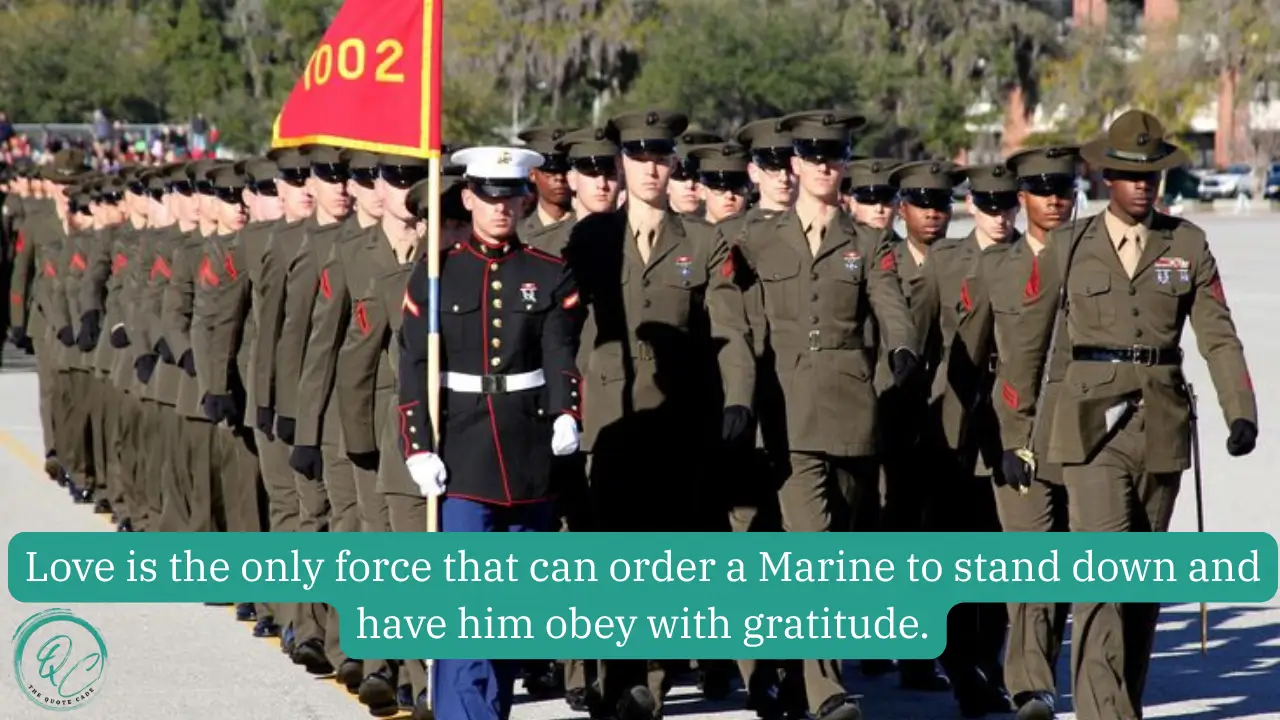
Love is the only force that can order a Marine to stand down and have him obey with gratitude. The moment of homecoming, when the constant state of alertness finally relaxes in the presence of true safety.
They issued me armor for my chest, but you are the reason I finally grew it around my heart. A realization after finding a lasting relationship, where love becomes the purpose behind the strength, not its replacement.
In your eyes, I am not a weapon. I am a man returned from the storm, and you are my quiet port. The profound relief of being seen for one’s humanity first, shared in letters or quiet moments after deployment.
My love for you operates on a different principle: not ‘first to fight,’ but ‘last to leave.’ The solemn, personal vow that extends the ethos of loyalty beyond service into a lifetime promise.
We don’t just share a life. We maintain a shared peace. I handle the vigilance so you can enjoy the calm. The unspoken division of emotional labor in a military relationship, where one carries the weight of past storms to preserve the other’s peace.
A true partner isn’t someone you come home to. They’re the reason your definition of ‘home’ changes from a place to a person. The shift felt during long deployments, where longing is no longer for a house, but for a specific heartbeat.
I was trained to hold a line in the sand. For you, I will build a fortress in the air, just to give you a place to dream safely. The creative, boundless commitment that emerges when a disciplined mind applies its focus to nurturing a partner’s spirit.
Love is the ultimate logistics chain: a constant, resilient supply of trust, delivered under any conditions. The practical understanding, born of planning complex operations, is that a relationship requires sustained, reliable effort to thrive.
You have the only set of orders I’ve ever been honored to follow without question. The voluntary surrender of a willful, trained spirit to the shared direction of a deep and trusted partnership.
Before you, my heart was a well-maintained piece of government equipment. After you, it became a sacred, personal relic. The transition from treating one’s inner life with functional discipline to regarding it with reverence because it houses another’s love.
We do not just weather storms. We become the shelter for each other, and the storm passes around us. The lesson learned in teamwork under pressure, applied to facing life’s external challenges as an unbreakable unit.
My commitment to you is my most important uniform. I wear it inwardly, always. The understanding that the deepest marks of belonging are not fabric, but invisible and permanent.
You are my strategic depth—the reserve of peace I can fall back to, that makes every forward advance possible. The tactical appreciation for a partner who provides the emotional foundation and haven that enables courage in the world.
I have carried heavy packs for miles. The weight of your trust is the only burden I feel honored to carry for a lifetime. A comparison made not to diminish struggle, but to elevate the privilege of being trusted with someone’s fragile heart.
Love is the final, and only, demilitarized zone I willingly inhabit. With you, I lay down all my defenses. The ultimate vulnerability and peace found with a true partner, where the constant guard maintained for the world is finally retired.
Start your week with calm clarity and motivation. Discover uplifting
Sunday motivational quotes
to refresh your mindset and welcome positive energy.
F. Marine Quotes About Death
For the Marine, death is not an abstract concept. It is a stark reality faced with clear eyes, a subject treated not with fear, but with a solemn, grounding honesty that shapes how they choose to live.
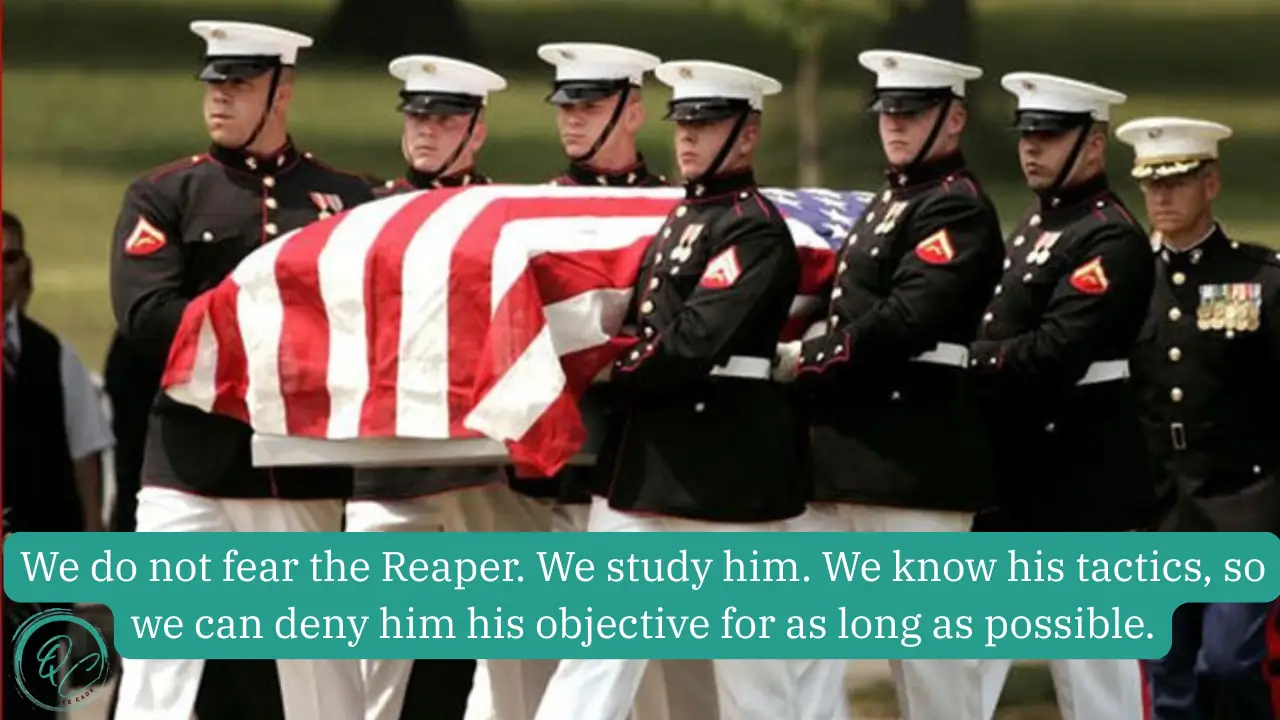
We do not fear the Reaper. We study him. We know his tactics, so we can deny him his objective for as long as possible. A cold analysis from combat training, treating mortality as an adversary to be outmaneuvered through skill and vigilance.
A Marine does not simply ‘pass away.’ They report to a final muster where the roll call is spoken in the legacy they left behind. The phrasing used in unit memorials reframes death as a permanent change of duty station.
The shadow of mortality is not a darkness to flee from. It is the contrast that makes every moment of brotherhood shine brighter. The heightened clarity and bonding experienced downrange, where proximity to loss intensifies the value of connection.
We are not taught to die for something. We are taught to live in such a way that our death, if required, is a logical footnote to a life of meaning. The core philosophy internalized from the Crucible, separating bravado from purposeful sacrifice.
Grief is not a sign of weakness. It is the receipt proving you invested your heart in another person. Honor the debt. The permission given to warriors to feel loss deeply, validating that mourning is the tribute paid to a bond.
The body is a temporary garrison. The spirit is the permanent occupant, and it has already been transferred to those who remember. A comfort shared after a KIA (Killed in Action), focusing on the enduring presence of a comrade’s influence.
Do not stand at my grave and weep. Stand in the position I held and understand why I considered it worth holding. The imagined words of a fallen Marine, directing attention from the loss to the purpose behind it.
We carry the dead not as a burden, but as a compass. Their memory points us toward living with more intention. The weight felt by survivors, transforming grief into a guiding force for their own conduct and choices.
A warrior’s death is not a tragedy of conclusion, but a transfer of responsibility. The mission is now yours to advance. The charge felt when taking over a position from a fallen brother, where mourning fuels continued resolve.
The final casualty report is not the end. It is a battlefield assessment. We note the loss, adjust our formation, and continue the advance. The harsh but necessary mindset in combat, where honoring the dead means refusing to let their sacrifice halt the mission.
I do not ask for a safe life. I ask for a life so fully engaged that my final breath is merely the last in a long series of purposeful ones. The personal prayer before a deployment, seeking notthe absence of risk, but a surplus of meaning.
They are not gone. They have just been assigned to guard a different perimeter—one in our history, our traditions, and our collective conscience. The spiritual belief spoken at a Battlefield Cross ceremony, assigning the fallen an eternal watch.
The pain of loss is the clean, sharp pain of a suture. It is the body of the unit closing a wound around a vacancy that will forever shape its form. The process of a unit healing after a loss, acknowledging the scar but also the mending.
You cannot cheat death. But you can stare it down for just long enough to let someone else get to safety. That is the only currency that matters. The essence of the ultimate sacrifice, framed not as a transaction with death, but as a gift of time to a brother.
We do not say ‘goodbye.’ We say ‘Carry on.’ The conversation is merely being handed to those who remain. The closing of a memorial service, where the focus is forcefully shifted to the living and the continuation of the legacy.
Conclusion
Scroll through the top Marine Corps quotes, and the reason is their timeless power. After studying lore for years, and the feats of men and women. These quotes are a reflection of those who hold the title of United States Marines.
These quotes are not words. But a culture built on discipline, intensity, and a relentless desire to do any mission. Each motivational line has a warrior’s spirit across time.
FAQs About Motivational Marine Quotes!
What is a good quote for the Marines?
“A Marine is defined not by the battles they win, but by the unbreakable fidelity to the Marines on their left and right. The mission changes; the brotherhood is permanent.”
What are 5 motivational quotes?
1. Courage is the quiet voice that says “try again” after doubt has finished shouting. 2. Your comfort zone is a story you told yourself about your limits. 3. The fastest way through a challenge is straight through its center. 4. Don’t pray for lighter burdens; pray for a stronger back. 5. The objective isn’t to fall, but to master the art of rising.
What is a famous quote about Marine life?
(Clarifying for ocean life) “The sea, once it casts its spell, holds one in its net of wonder forever,” by Jacques Cousteau, captures the ocean’s mesmerizing grip on the human spirit.
What is a powerful ocean quote?
“The ocean is a mighty harmonist,” wrote William Wordsworth. Its immense, rhythmic power can simultaneously evoke awe for nature’s force and a profound sense of inner peace.
What is a beautiful sea quote?
“The sea, blurred and hazy in the morning light, was a mirror of polished silver, holding the sky’s pale glow in a perfect, still embrace,” capturing a serene seascape moment.