

I know there come days when rest for women looks like an outdated idea. It is not a kind of tired a nap problem. It is what builds inside a woman, a layered weariness that settles into bones. This is when life won’t slow down; she’s tired, quotes come up to heal.
When she is running on empty soul. These words are what hold her together mentally and physically. What I have learned is that women won’t turn to quotes because it is cheap motivation. It is because they found clarity in these chosen words.
These quotes are quite a reminder that she’s not alone. When your inner voice has gone silent from the sheer exhaustion of keeping up.
1. She’s Tired Quotes Shorts
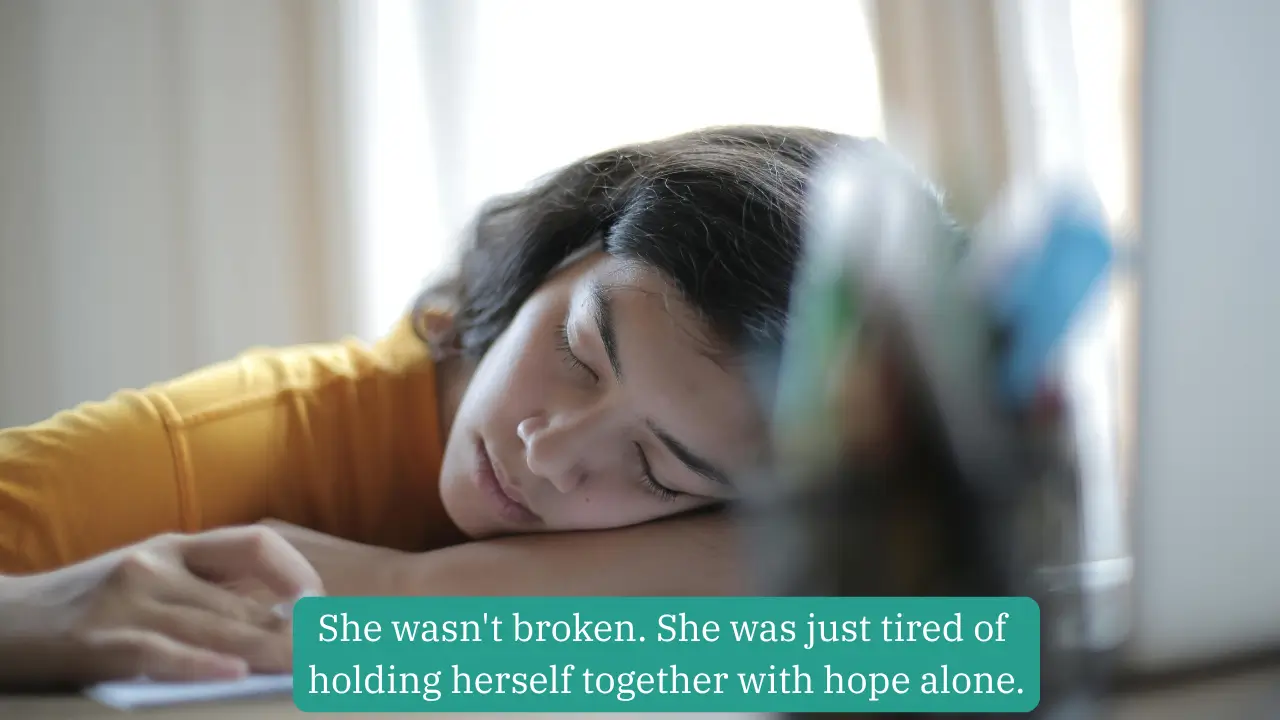
She carries the world in silence, never complains, never asks for help. These quotes are for the woman who never explains her efforts. They are meant to land, so she finally has a way to breathe.
- She wasn’t broken. She was just tired of holding herself together with hope alone.
How does it help her revive? Validates that exhaustion doesn’t equal failure. It reframes her weariness as a natural response to prolonged effort, not a character flaw. - Rest isn’t a reward for finishing. It’s the right of someone still in the fight.
How does it help her revive? Removes the guilt from pausing. She doesn’t need to earn her rest; she needs it to continue. - Some days, she’s not giving up. She’s just putting down what was never hers to carry.
How does it help her revive? Creates a mental permission slip to release burdens — other people’s expectations, problems, and emotional weight — that drained her unnecessarily. - She stopped romanticizing the struggle and started honoring her stillness.
How does it help her revive? Shifts the narrative from “pushing through gloriously” to “pausing wisely.” Stillness becomes a form of self-respect. - Tired eyes still see clearly when they finally look inward.
How does it help her revive? Suggests that her exhaustion is an invitation to turn her gaze from external demands to internal needs. Clarity lives there. - Her softness was never a weakness. It was evidence of how much she endured without becoming hard.
How does it help her revive? Honors the emotional labor hidden beneath her fatigue. She can reclaim her gentleness as strength, not surrender. - She didn’t need to be fixed. She needed to be removed from what broke her.
How does it help her revive? Points outward — at environments, roles, or relationships — instead of making her the problem. Revival begins with the right departure. - A tired woman who still chooses herself is a revolution in slow motion.
How does it help her revive? Reframes self-prioritization as an act of powerful, patient defiance. She doesn’t have to be loud to be transformative. - She wasn’t lazy. She was under-rested in a world that profits from her exhaustion.
How does it help her revive? Names the systemic pressure behind her burnout. It’s not a personal failing; it’s a conscious rejection of a culture that extracts relentlessly. - Quitting isn’t the tragedy. Losing herself in the process is.
How does it help her revive? Liberates her from the shame of walking away. The real danger was never leaving; it was disappearing. - She learned that empty isn’t the end. Sometimes empty is the first honest place she’s stood in years.
How does it help her revive? Redefines emptiness as a clean starting point, not a void. Honesty about her depletion is the ground on which she rebuilds. - Her energy didn’t vanish. It just got tired of going where it wasn’t valued.
How does it help her revive? Frames energy as having wisdom, not scarcity. She’s not depleted; she’s discerning. Now she knows where to redirect it. - She’s not asking for less on her plate. She’s asking for a plate that’s actually hers.
How does it help her revive? Moves her from overwhelm to ownership. The problem isn’t volume; it’s alignment. She’s ready to own her life, not just manage a list. - The version of her that’s exhausted — she’s not the final draft.
How does it help her revive? Injects hope without toxic positivity. Today’s fatigue is a chapter, not the whole story. The author is still writing. - She will rise. Not because she was told to, but because she finally heard her own voice asking her to.
How does it help her revive? Anchors motivation internally. Her comeback isn’t inspired by external pressure or clichés; it’s pulled by her own quiet, undeniable call.
✨ Looking for uplifting words that inspire hope, confidence, and optimism about what lies ahead? Explore encouraging positive-future quotes to stay focused on brighter possibilities, personal growth, and a more successful and fulfilling tomorrow.
2. She’s Tired Quotes Relationships

She stopped asking for love that required her to sacrifice herself. The right relationship will never want her to ignore herself. These quotes are to heal women who are too tired to carry the emotional weight alone.
- She didn’t leave because she stopped loving. She left because loving him meant disappearing from herself.
How does this give your relationship a new path? Recognizes the quiet tragedy of self-abandonment. The new path begins when she realizes that a love that costs her identity is no longer sustainable — and that reclaiming herself is not betrayal, but survival. - She was tired of being the only one who remembered what they promised each other.
How does this give your relationship a new path? Names the loneliness of one-sided commitment. From here, the relationship either confronts the imbalance honestly or makes space for something that doesn’t require her to be the sole memory-keeper. - Silence taught her more about his intentions than his words ever did.
How does this give your relationship a new path? Moves her from deciphering empty words to trusting observable patterns. The new path values consistency over charm, and action over explanation. - He called her moody. She was just finally reacting to what she’d been quietly accepting for years.
How does this give your relationship a new path? Frames her emotional response not as instability but as delayed justice. This awareness stops the cycle of gaslighting and invites relationships built on genuine accountability. - A love that requires her to constantly prove her worth isn’t love — it’s a job interview that never ends.
How does this give your relationship a new path? Exposes performance-based affection for what it is. The healthier path demands mutual acceptance, not endless auditions. - She stopped romanticizing potential and started responding to reality.
How does this give your relationship a new path? Breaks the spell of “someday he’ll change.” The path forward is built on what is, not what could be if she just suffers long enough. - Her heart didn’t harden. It just finally learned to be selective with the door it opened.
How does this give your relationship a new path? Reframes her boundaries not as bitterness but as wisdom earned. Selective entry is self-honor, not coldness. - Tired isn’t just physical. Sometimes it’s the weight of hoping someone will become the person they promised they already were.
How does this give your relationship a new path? Names the emotional exhaustion of waiting for a transformation that was never coming. The path shifts from waiting on him to walking toward herself. - She stopped making herself small to fit into a love built for someone else.
How does this give your relationship a new path? Rejects the architecture of a relationship designed without her fullness in mind. The new structure must accommodate her real dimensions — not her edited version. - She gave him her depth, and he waded in the shallow end. That was never her failure.
How does this give your relationship a new path? Releases her from the belief that she was “too much.” The right relationship will swim toward her depths, not retreat from them. - The exhaustion came when she realized she was fighting for a connection only one of them was trying to save.
How does this give your relationship a new path? Reveals the breaking point with painful clarity. When the fight is singular, the only revival possible is hers — not theirs. - She wasn’t asking for perfection. She was asking for presence, and even that felt like begging.
How does this give your relationship a new path? Lowers the bar to the bare minimum and still finds it unmet. This recognition drives a path where emotional availability is the starting line, not the finish line. - Her silence became louder than her arguments. That’s when he should have listened most.
How does this give your relationship a new path? Marks the dangerous transition from fighting to disengaging. A woman who has stopped speaking is a woman already half-gone — a warning and a turning point. - She outgrew the version of herself that settled for crumbs, and she stopped apologizing for her hunger.
How does this give your relationship a new path? Reframes her needs not as greed but as growth. A new path demands a table where she is fed, not one where she’s grateful for leftovers. - She didn’t need a love that completed her. She needed one that didn’t keep emptying her.
How does this give your relationship a new path? Shatters the fairytale of completion and replaces it with a more honest metric: sustainability. The right love replenishes rather than drains.
🔥 Need uplifting words that remind you how resilient, brave, and capable you truly are inside? Read you’re-stronger-than-you-seem quotes to overcome self-doubt, stay mentally tough, and find encouragement during life’s most challenging moments.
3. Tired Quotes About Life

Life does not shout when you are tired. Sometimes it reflects without drama through routines. These quotes were to reflect the soul-deep tiredness that carries the thousand small weights.
- Being tired isn’t always about lack of sleep. Sometimes it’s the soul asking for a life it doesn’t dread waking up to.
What does this teach when you’re tired? The exhaustion isn’t just physical. It’s a signal to examine what you’re waking up for — and whether that life is truly yours or one you fell into. - You can be grateful for everything you have and still be exhausted by it.
What does this teach when you’re tired? Gratitude and fatigue can coexist. You don’t have to dismiss your tiredness just because others have it harder. Acknowledging both is emotional honesty, not selfishness. - She wasn’t running from her life. She was walking slowly enough to finally see which parts were breaking her.
What does this teach when you’re tired? Slowing down isn’t an escape. It’s an inspection. Tiredness creates the pause needed to identify what needs changing rather than just enduring. - No one notices the weight of a life lived quietly for everyone else.
What does this teach when you’re tired? Your exhaustion is often invisible because your labor is invisible. Teaching yourself to notice it first — without waiting for external validation — is the first step toward offloading. - Healing doesn’t always look like progress. Sometimes it looks like sitting on the floor at 2 PM and admitting you’re not okay.
What does this teach when you’re tired? Surrender is part of recovery. Teaching yourself that collapse can be a form of honesty rather than failure removes the shame that compounds exhaustion. - The world will take everything you offer and ask if you have more. Your boundaries are the only answer it understands.
What does this teach when you’re tired? The system won’t stop extracting. Teaching yourself to stop offering is a survival skill — not selfishness, but self-preservation in a hungry world. - She finally understood that rest isn’t a pause between achievements. Rest is the achievement.
What does this teach when you’re tired? Reframes rest as the goal, not the interruption. Teaching your nervous system that stillness has value separate from productivity is revolutionary in a burnout culture. - Some days, the bravest thing you’ll do is disappoint people who are used to your unlimited availability.
What does this teach when you’re tired? Disappointment isn’t a crisis. Teaching yourself to tolerate others’ temporary frustration protects your long-term well-being. - Tiredness is sometimes the only language the body has left when you’ve ignored every other signal.
What does this teach when you’re tired? Your body escalates when you don’t listen. Teaching yourself to hear the whispers of fatigue prevents the scream of collapse. - She wasn’t lazy. She was grieving the version of herself who could do it all without breaking.
What does this teach when you’re tired? The loss of your former capacity is a real loss. Teaching yourself to grieve it honestly makes space for a more sustainable version of you to emerge. - The grind convinced her she was building an empire. Her exhaustion revealed she was just building a cage.
What does this teach when you’re tired? Tiredness often exposes the truth that ambition is disguised. Teaching yourself to recognize when busyness has become imprisonment is a painful but necessary awakening. - You don’t owe the world a well-rested version of yourself. You owe yourself that.
What does this teach when you’re tired? The motivation for rest shouldn’t be better performance. Teaching yourself to rest for you — not for improved output — reclaims rest as an act of self-love. - She stopped explaining her exhaustion and just started honoring it.
What does this teach when you’re tired? Justification is exhausted further. Teaching yourself that your tiredness is valid without a dissertation liberates energy for actual recovery. - A life that constantly drains you isn’t testing your strength. It’s revealing its unsustainability.
What does this teach when you’re tired? The lesson isn’t to get stronger. It’s to recognize that some circumstances aren’t challenges to overcome but exits to take. - She wasn’t giving up on life. She was finally choosing one that gave back.
What does this teach when you’re tired? Choosing a reciprocal life isn’t surrender. Teaching yourself that reciprocity is a reasonable standard — not a luxury — changes what you’ll accept.
🌞 Searching for uplifting words that encourage happiness, gratitude, and a brighter daily mindset? Discover choose-to-be-happy quotes to inspire self-growth, emotional peace, and a more joyful outlook on life no matter what challenges arise.
4. Emotionally Tired Quotes

Emotional exhaustion is not always noticed early. Ti settles into the space, feeling not important, and leaves the scars without even noticing. For a woman with this burden, the right understanding by her partner can create a difference. These quotes are for such women who have given too much and have nothing left to offer.
- She’s not cold. She’s just been the only warmth in too many empty rooms.
Why is her emotional tiredness important to notice for your relationship? When she withdraws, it’s easy to label it as disinterest. But this quiet signals years of overextending emotionally without replenishment. Recognizing this can shift your response from resentment to compassion — and open a conversation she’s too drained to start. - Her silence isn’t peace. It’s a battlefield she’s too exhausted to describe.
Why is her emotional tiredness important to notice for your relationship? Mistaking her quiet for contentment is a dangerous misread. Her silence often means she’s processing alone what she no longer has energy to explain. Noticing this invites you to gently ask, not demand, what’s happening inside her. - She stopped crying, not because things got better, but because tears require energy she no longer has.
Why is her emotional tiredness important to notice for your relationship? The absence of visible emotion isn’t healing — it’s depletion. When she stops expressing pain, she may be entering emotional shutdown. Your awareness here can be the lifeline that pulls her back before she disconnects completely. - Emotionally drained doesn’t mean emotionally dead. It means the well is empty,y and she’s still being asked to draw water.
Why is her emotional tiredness important to notice for your relationship? She may still be functioning, still showing up, but resenting every pull on her emotional reserves. Recognizing this helps you stop making withdrawals from an account that’s already overdrawn. - She’s not difficult to love. She’s just been loved by people who only knew how to take.
Why is her emotional tiredness important to notice for your relationship? Her guardedness isn’t about you — it’s a learned survival response. Understanding this history lets you approach her defensiveness with patience rather than frustration, proving through consistency that you’re different. - Her heart didn’t harden overnight. It calloused one disappointment at a time.
Why is her emotional tiredness important to notice for your relationship? What looks like emotional unavailability is often accumulated scar tissue. Each layer represents a moment she needed softness and received something else. Your gentleness now matters more than your explanations. - She’s tired of being the one who remembers, who notices, who carries what everyone else forgets.
Why is her emotional tiredness important to notice for your relationship? The mental and emotional load she bears — remembering dates, sensing tension, managing moods — is invisible labor. Seeing this burden and actively sharing it can relieve her before she collapses under its weight. - Sometimes she doesn’t need solutions. She needs someone to sit beside her in the mess without trying to clean it up.
Why is her emotional tiredness important to notice for your relationship? The instinct to fix is often a way of rushing past her pain. Her exhaustion is sometimes asking for presence, not answers. Learning this distinction can transform how she experiences you. - She gave her best years to people who treated her like a placeholder. Now she wonders if there’s anything left to give.
Why is her emotional tiredness important to notice for your relationship? This isn’t melodrama — it’s the aftermath of investing deeply in relationships that didn’t honor her. Your consistent, patient presence can quietly prove she’s not too late and she’s not too much. - Emotional exhaustion is what happens when she’s been strong for so long she’s forgotten what it feels like to be supported.
Why is her emotional tiredness important to notice for your relationship? She may not know how to ask for help because she’s been conditioned to be the helper. Noticing this allows you to offer support she can’t request — creating safety she didn’t know was possible. - She’s not ignoring you. She’s just having conversations in her head that have exhausted her before they’ve begun.
Why is her emotional tiredness important to notice for your relationship? Sometimes she pre-processes entire conflicts internally, anticipating outcomes based on past disappointments. Your patience during her processing isn’t passive — it’s an active understanding that rebuilds trust. - A woman emotionally spent doesn’t need reminders of her responsibilities. She needs relief from them.
Why is her emotional tiredness important to notice for your relationship? Listing what she hasn’t done only deepens her depletion. Noticing this shifts your role from manager to partner, from adding weight to lifting it — even in small, tangible ways. - Her emotional capacity isn’t infinite. Every “I’m fine” costs her something she’s not getting back.
Why is her emotional tiredness important to notice for your relationship? The casual dismissal of her own feelings is a survival mechanism that extracts a hidden toll. Recognizing “I’m fine” as a withdrawal notice rather than reassurance can change how you respond to those two words. - She’s been the anchor for so long, she’s forgotten what it feels like to be held.
Why is her emotional tiredness important to notice for your relationship? Anchors are strong but stationary — and deeply alone. She may not know how to receive support because it’s been so long since anyone offered. Your initiative in holding her steady can be quietly revolutionary. - The woman who says she has nothing left is often the one who gave everything and was never refilled.
Why is her emotional tiredness important to notice for your relationship? Her emptiness isn’t a character flaw — it’s evidence of a history of unequal emotional exchange. Seeing this truth can shift your entire approach from judgment to genuine partnership.
5. Mentally Tired Quotes

Mental exhaustion is a common type of unknown tiredness. A mind that is running between chores without leaving the starting line. The following quotes are for a woman whose mind never rests.
- Her mind wasn’t empty. It was too full of things she couldn’t turn off.
What does this tell us about mental tiredness? Mental fatigue isn’t about having no thoughts — it’s about having too many that refuse to quiet. The exhaustion comes from the inability to find an off-switch, not from a lack of stimulation. - She was tired of thinking about things that hadn’t even happened yet.
What does this tell us about mental tiredness? So much mental energy is spent on hypothetical futures that never materialize. This reveals how mental tiredness is often borrowed from tomorrow’s uncertainties rather than today’s realities. - Her brain wasn’t broken. It was just running too many programs at once, with no permission to shut down.
What does this tell us about mental tiredness? Like a computer with infinite tabs open, her mind is performing background operations constantly. Mental exhaustion is the lag that comes from never closing anything. - She didn’t need sleep. She needed her thoughts to stop replaying conversations she’d already survived.
What does this tell us about mental tiredness? Mental fatigue persists beyond physical rest because the mind keeps revisiting what the body has already left behind. Sleep doesn’t always silence rumination. - Overthinking isn’t a hobby she chose. It’s a job her mind assigned her without pay.
What does this tell us about mental tiredness? She didn’t sign up for endless analysis, but her brain treats it as mandatory labor. Mental tiredness is working a shift nobody asked for, without compensation or breaks. - She wasn’t lazy. She was mentally under construction in a zone that never closed for the night.
What does this tell us about mental tiredness? Constant mental processing is invisible work that looks like idleness from the outside. Her stillness often disguises intense internal activity that never pauses. - Her mind was a browser with seventeen tabs open, and she’d lost track of where the music was coming from.
What does this tell us about mental tiredness? Mental exhaustion feels like scattered attention with an unidentified source of stress. The noise is constant, but its origin becomes impossible to locate. - She was exhausted by decisions that seemed small to everyone else but felt monumental to her.
What does this tell us about mental tiredness? Decision fatigue is real and deeply personal. What looks trivial to observers can be the final weight on an already overloaded cognitive system. - Her mental energy wasn’t low. It was being spent in places nobody could see.
What does this tell us about mental tiredness? The invisibility of mental labor makes it isolating. She’s making withdrawals from an account nobody acknowledges exists, let alone helps replenish. - She didn’t need a vacation. She needed her mind to stop treating every thought like an emergency.
What does this tell us about mental tiredness? Mental exhaustion isn’t always cured by external breaks. It requires an internal recalibration where thoughts stop triggering fight-or-flight responses. - The noise wasn’t outside. It was in her head, and it hadn’t been quiet in years.
What does this tell us about mental tiredness? Mental fatigue can exist even in perfect external silence. The chaos is internal, persistent, and immune to environmental changes alone. - She was mentally done before the day even started. That’s what happens when rest isn’t restful.What does this tell us about mental tiredness? True mental rest isn’t just the absence of activity — it’s the presence of peace. Without it, sleep becomes merely physical, leaving the mind still running.
- Her brain wasn’t tired from thinking too little. It was exhausted from thinking about everything all at once.
What does this tell us about mental tiredness? The problem isn’t intellectual deficiency but cognitive overload. The mind wasn’t designed to process everything simultaneously without filtration. - She craved mental silence more than she craved sleep.
What does this tell us about mental tiredness? There’s a distinct hunger for stillness of thought that surpasses physical tiredness. The mind seeks quietude that even unconsciousness doesn’t guarantee. - A tired mind still loves. It just doesn’t have the bandwidth to explain it.
What does this tell us about mental tiredness? Mental exhaustion doesn’t erase emotion — it erases the capacity to articulate it. The feelings remain; the words to express them get lost in the fog.
🌙 Searching for realistic life quotes that help you cope with setbacks and protect your peace of mind? Explore expect-disappointment quotes to build emotional resilience, manage expectations wisely, and stay mentally stronger through difficult situations.
6. Tired Quotes for Tired Parents

Parenting is not a job, but a job where you are never paid and never appreciated. You get drained and fall in love at the same time. The following quotes are for the parents who have given their all and are still finding more to give.
- Parenting isn’t just losing sleep. It’s losing the version of yourself who could finish a thought without interruption.
What does this want us to think about parents? Behind the visible fatigue is a deeper loss of mental autonomy. Parents sacrifice not just rest but the simple luxury of uninterrupted thinking — and that cognitive fragmentation deserves recognition and compassion. - They’re not just tired. They’re giving their energy to small humans who don’t yet understand the cost of the transfer.
What does this want us to think about parents? Every ounce of parental energy is a voluntary donation to someone who can’t yet say thank you. This isn’t a complaint — it’s a quiet miracle happening on repeat, unnoticed. - A tired parent isn’t failing. They’re proof that love is a physical act, not just a feeling.
What does this want us to think about parents? The exhaustion is evidence of love made tangible. When we see tired parents, we’re witnessing love that shows up with its sleeves rolled up, not just its heart open. - They gave up sleeping in, spontaneous plans, and bathroom privacy — and they’d do it all again before breakfast.
What does this want us to think about parents? The sacrifices parents make are so numerous that they become invisible even to themselves. Recognizing the scale of what’s been surrendered without hesitation is essential to honoring them. - Behind every clean child is a parent who hasn’t had a shower themselves in three days.
What does this want us to think about parents? The math of parental care is almost never equal. Someone else’s well-being is constantly prioritized over their own, and that imbalance deserves to be seen and acknowledged. - Parenting is the art of being completely overwhelmed while still being someone’s safe place.
What does this want us to think about parents? Parents hold it together not because they’re not struggling, but because someone needs them to be steady. That emotional regulation while internally drowning is a profound act of love. - They miss who they were before kids, while simultaneously not wanting to go back to a life without them. That’s the beautiful contradiction of parenthood.
What does this want us to think about parents? Parents can hold two truths at once: grief for their former self and deep gratitude for their current life. This complexity doesn’t make them ungrateful — it makes them human. - A parent’s tiredness isn’t just physical. It’s the weight of being responsible for someone else’s entire emotional foundation.
What does this want us to think about parents? Beyond the sleepless nights is the existential weight of shaping a human being. Parents carry the invisible burden of trying not to mess up someone else’s life while barely managing their own. - They’re running on cold coffee, interrupted conversations, and a love so deep it scares them.
What does this want us to think about parents? The fuel for parenting isn’t sleep or caffeine — it’s a fierce love that persists despite depleted resources. That love deserves to be honored, not just admired from a distance. - No one tells you that parenting means being someone’s entire emotional support system while your own support system gathers dust.
What does this want us to think about parents? Many parents are giving emotional care they’re not receiving. The isolation of being everyone’s pillar while having no one to lean on is a silent crisis that needs attention. - The tired parent isn’t asking for a medal. They’re just hoping someone notices they haven’t sat down in four years.
What does this want us to think about parents? Recognition isn’t about praise — it’s about visibility. Parents often don’t need help as much as they need to feel seen in their relentless, invisible labor. - Parenting taught them exhaustion they didn’t know existed — and a love they couldn’t have imagined. Both are real. Both deserve space.
What does this want us to think about parents? The exhaustion and the love aren’t opposites that cancel each other out. They coexist, and allowing parents to name both honestly without guilt is a gift. - They’re touched out, talked out, and completely poured out — but somehow they still show up for one more bedtime story.
What does this want us to think about parents? The capacity of parents to give beyond empty is almost incomprehensible. That “one more” — one more story, one more hug, one more reassurance — is where love transcends human limits. - Before judging a tired parent, remember: they’re making a thousand decisions a day for someone who can’t make their own.
What does this want us to think about parents? The cognitive load of parenting is invisible and relentless. Every judgment of a parent ignores the sheer volume of choices they’ve already made just to get through the morning. - The house is a mess, the laundry is multiplying, and the parents are surviving on hope and half-eaten toddler snacks. This is a love story.
What does this want us to think about parents? The chaos isn’t a sign of failure — it’s the backdrop of a love story unfolding in real-time. The mess is temporary, but the love being built in it is permanent.
☀️ Want a thoughtful way to check on someone and make their day feel a little brighter? Discover sweet hope-your-day-is-going-well messages to express kindness, spread positivity, and strengthen personal connections with meaningful everyday words.
7. She’s Strong, but She’s Tired
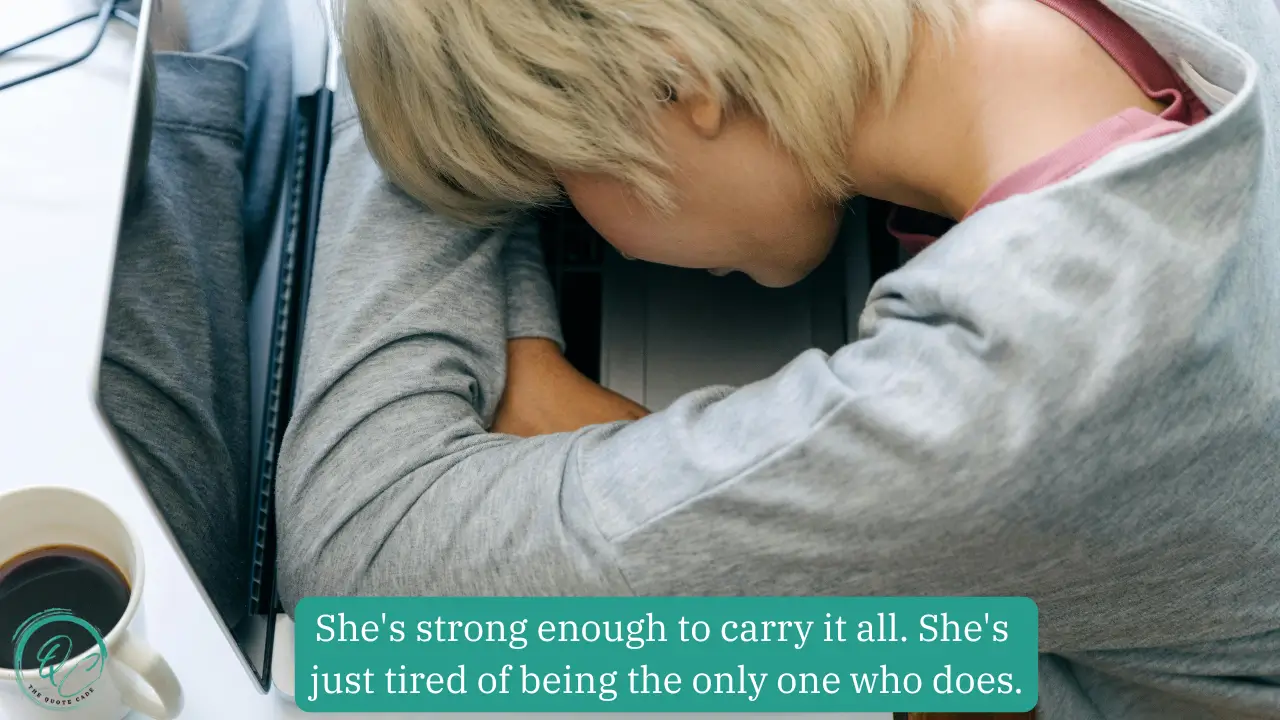
Strength and exhaustion both come side by side. In the same soul sharing space in the same woman. They together allow her to feel their weight. The following quotes are for the woman who celebrates her strength and never expresses her fatigue.
- She’s strong enough to carry it all. She’s just tired of being the only one who does.
What does this tell us about being strong but tired? Her strength has become a reason for others to offload rather than offer support. The exhaustion comes not from incapacity but from isolation — being the designated carrier in a world that mistakes her capability for infinite capacity. - Everyone calls her resilient. Nobody asks what resilience has cost her.
What does this tell us about being strong but tired? Resilience is often praised without acknowledging its price tag. Each bounce back has withdrawn from an account nobody helped refill, and the balance is showing. - She didn’t break. But she came close enough to realize breaking would have been healthier than bending forever.
What does this tell us about being strong but tired? Flexibility has limits that her strength helped her ignore. The tiredness comes from realizing that permanent adaptation to untenable situations isn’t strength — it’s slow self-erasure. - Strong women get tired too. The difference is they’ve learned to cry while still moving forward.
What does this tell us about being strong but tired? Strength isn’t the absence of pain or fatigue — it’s the refusal to stop even when both are present. But that forward motion, while admirable, still deserves acknowledgment of its weight. - She held it together so long she forgot she was allowed to fall apart.
What does this tell us about being strong but tired? The performance of strength became so convincing that she believed it herself. Her exhaustion is the truth finally catching up to the role she’s been playing for everyone else’s comfort. - They call her a rock. Even rocks erode eventually.
What does this tell us about being strong but tired? Being someone’s foundation is an honor that comes with hidden erosion. Even the most solid structures wear down under constant pressure, and her tiredness is evidence of years of weathering. - She’s not asking for less weight. She’s asking why she’s the only one who knows how heavy it is.
What does this tell us about being strong but tired? The burden itself isn’t the problem — it’s the invisibility of it. She’s exhausted from carrying loads nobody else seems to see, let alone offer to share. - Strength became her reputation. Tired became her secret.
What does this tell us about being strong but tired? The gap between how she’s perceived and how she actually feels has become a chasm. Her public identity and private reality exist in different worlds, and maintaining that separation is itself exhausting. - She can survive almost anything. She’s just tired of proving it.
What does this tell us about being strong but tired? The constant testing of her strength has become the exhaustion itself. She doesn’t need more evidence of her resilience — she needs circumstances that don’t require it so frequently. - Behind her “I’ve got this” is a woman who wishes someone would say “I’ve got you.”
What does this tell us about being strong but tired? Her declarations of capability are often unspoken pleas for partnership. The strength she displays is partially a defense mechanism developed in the absence of reliable support. - The strongest thing she’ll ever do isn’t endure more. It’s admitted she’s running on empty.
What does this tell us about being strong but tired? True strength isn’t endless endurance — it’s the courage to acknowledge limits. Her tiredness, when voiced, is actually the most honest display of power she owns. - She’s not weak for being tired. She’s human for finally feeling what strength kept numbing.
What does this tell us about being strong but tired? The exhaustion is actually a return to full humanity after the survival mode that strength required. Feeling tired is progress, not regression. - She built everyone else’s shelter while standing in the rain herself.
What does this tell us about being strong but tired? Her strength was spent constructing safety for others while neglecting her own. The tiredness is simply her finally noticing she’s been soaking wet all along. - The woman who always shows up is sometimes the one most in need of someone showing up for her.
What does this tell us about being strong but tired? Her reliability has created a dynamic where her needs are never on the agenda. The exhaustion is the accumulated deficit of always being the giver in a world of takers. - She’s strong. She’s tired. Both are true. Neither cancels the other out.
What does this tell us about being strong but tired? This is the ultimate reconciliation. Her strength and her fatigue coexist legitimately, neither diminishing the other. She doesn’t have to choose between being powerful and being depleted — she is both, fully and honestly.
🎁 Looking for cheerful holiday words that spread warmth, joy, and festive happiness to loved ones? Explore heartwarming merry-and-bright quotes to make Christmas messages more meaningful, uplifting, and full of seasonal positivity.
8. Helpful Tired Quotes to Give You New Energy

Exhaustion does not always mean you are doing something wrong. It is proof that you are doing right for too long without appreciation. These quotes do not mean ignore fatigue, but how you see it during unexpected times.
- Rest isn’t the opposite of productivity. It’s the soil where the next season of you grows.
How does this give new energy? Reframes rest from something you do when you’re done to something you do so you can begin again. Energy returns when you stop treating rest as a reward and start treating it as a foundation. - Your exhaustion is not a weakness. It’s a signal that you’ve been running on outdated fuel.
How does this give new energy? Shifts the problem from “I’m not enough” to “my current approach needs updating.” New energy comes from changing the source, not from pushing harder on empty. - The pause you’re afraid to take might be the only thing standing between you and the energy you’ve been begging for.
How does this give new energy? Names the fear that keeps people running past their limits. Energy often appears the moment you finally stop chasing it and allow stillness to do its work. - You’re not starting over. You’re starting from experience, and experience knows when to rest.
How does this give new energy? Eliminates the shame of pausing by reframing it as wisdom rather than failure. Energy flows back when you realize you haven’t lost ground — you’ve gained discernment. - Even the sun sets every evening. Even the earth rests between seasons. You are not exempt from nature’s rhythm.
How does this give new energy? Connects human exhaustion to the natural world, removing the guilt of needing rest. Energy returns when you align with cycles instead of fighting them. - Fatigue is often just clarity in disguise — it tells you what’s draining you and what’s worth your remaining energy.
How does this give new energy? Transforms tiredness into information rather than an enemy. Energy sharpens when you use exhaustion as a compass that points toward what needs to change. - The energy you’re chasing won’t be found in another cup of coffee. It’s waiting in the boundary you haven’t set yet.
How does this give new energy? Redirects the search for energy from consumption to protection. Real renewal comes not from adding more stimulants but from removing what’s been draining you unchecked. - Your body isn’t betraying you by being tired. It’s being honest with you — finally.
How does this give new energy? Shifts the relationship with fatigue from adversarial to collaborative. Energy emerges when you stop fighting your body’s signals and start listening to what they’re trying to protect. - The most productive thing you can do today is restore yourself enough to be present for tomorrow.
How does this give new energy? Redefines productivity to include self-renewal. Energy flows when you realize that resting is an investment in future capacity, not a withdrawal from current responsibility. - Tiredness is not a permanent state. It’s a season, and seasons always change when we let them.
How does this give new energy? Injects hope without dismissing the current struggle. Energy stirs when you remember that exhaustion has an expiration date if you honor its presence rather than resist it. - You don’t need to earn rest. You need to unlearn the lie that exhaustion is a status symbol.
How does this give new energy? Challenges the cultural glorification of burnout. New energy comes from rejecting the idea that your worth is measured by how depleted you are willing to become. - Sometimes the most energizing thing you can do is absolutely nothing — and refuse to feel guilty about it.
How does this give new energy? Gives explicit permission for stillness without shame. Energy regenerates when the guilt that normally accompanies rest is consciously dismissed. - The energy you’ve lost isn’t gone. It’s just scattered across a hundred things that aren’t yours to carry.
How does this give new energy? Suggests that energy isn’t missing — it’s misallocated. Renewal begins when you gather your energy back from obligations, worries, and burdens that were never meant for you. - You’re not lazy. You’re just trying to pour from a cup that’s been empty longer than you’d like to admit.
How does this give new energy? Removes the self-criticism that compounds exhaustion. Energy returns when you stop berating yourself for being empty and start refilling with compassion instead of judgment. - The most powerful energy source you have isn’t motivation. It’s permission — permission to stop, to breathe, to begin again differently.
How does this give new energy? Shifts the source of renewal from external motivation to internal authorization. True energy ignites when you grant yourself the right to move at a pace that sustains you rather than destroys you.
🌿 Conclusion
After years of writing words for women, I have learned that everyone feels tired. The women who find their way back are those who learn how to sit with it. They move through it rather than pretend it’s ok.
This is exactly what these quotes do and matter more. What you need is to understand. Don’t need to be fully recharged to take the next step. This the first sign that you are healing.
FAQ’s: (Frequently Ask Questions)
-
When tired, quote short?
Short quotes cut through mental fog instantly. They validate exhaustion without demanding energy she doesn’t have. A single line can remind her she’s not broken, just human and depleted.
-
What to tell her when she’s tired?
Tell her you see it. Say “Rest, I’ll handle this” without waiting to be asked. Acknowledge her invisible labor. She doesn’t need solutions — she needs permission and presence.
-
How to express feeling tired?
Say “I’m running on empty” or “My mind feels heavy.” Name where it lives — body, mind, or heart. Use metaphors: drained battery, wading through fog, carrying an invisible weight that never lifts.
-
When feelings hurt quotes?
Quotes help when emotional pain feels isolating. A well-chosen line mirrors your wound and whispers you’re not alone. They translate ache into language when your own words fail.
-
How to express feeling hurt?
Be specific without blaming. Say “I felt invisible when…” or “That landed hard for me.” Own the feeling rather than attacking. Vulnerability expressed clearly invites repair, not more distance.