Speaking from my own failures and relationships. Non-apologies can cut deeper than the original fight. The tension builds, and hurt feelings settle in. The long apology paragraphs to win her back actually work.
These apology paragraphs have genuine emotional intelligence. These are meaningful and crafted for your relationship. They rebuild trust and acknowledge her heart’s experience. They open the door to healing, forgiveness, and reconciliation.
So, stop circling the wounds and start rebuilding the emotional bond. It allows two people to keep moving forward together.
Table of Contents
Toggle1. Long Apology Paragraphs to Win Her Back After an Argument

An argument never ends when the shouting stops. It remains alive in the quiet corners. It only ends when you both understand. The right words are the key for the moment. The following paragraphs can heal the deepest crack.
- When you apologize, don’t just offer your words—offer the silence after them. It’s in that quiet space that she’ll decide whether you’re performing regret or actually carrying it. Most men fill the pause with justifications, and in doing so, they lose the very thing they’re trying to reclaim.
How arguments destroy, and this paragraph can restore? An argument plants a seed of doubt about whether you truly see her. This paragraph addresses that by shifting the focus from your defense to her need for space to process. - Stop explaining the logic behind your mistake and start describing the weight of it. She doesn’t need a flowchart of why you were right to be upset; she needs to know that you’ve counted the hours she’s been hurt, that you’ve replayed the moment and flinched each time. Logic built the wall; emotion has to tear it down.
How arguments destroy, and this paragraph can restore? Heated debates reduce her pain to a problem to be solved. This resolves it by prioritizing emotional acknowledgment over intellectual explanation. - An apology that overuses the word “but” is just a defense mechanism in formal wear. Every time you attach a qualifier to your remorse, you hand her back a piece of the blame you’re supposed to be absorbing. Let your sorry stand naked—unqualified, unprotected, and completely hers to judge.
How arguments destroy, and this paragraph can restore? Defensiveness adds insult to injury. This paragraph strips away self-protection, letting the apology carry full weight. - Remember that you aren’t just apologizing for the words that came out of your mouth; you’re apologizing for the safety that left the room when you raised your voice. Trust is a quiet currency, and arguments are bank robberies. The repayment must be louder, softer, and longer than the theft.
How arguments destroy, and this paragraph can restore? Conflict steals emotional security. This reframes the apology as a long-term act of restoration, not a quick fix. - She might have forgiven the action, but she hasn’t forgotten the loneliness that followed it. That’s where your long apology must live—not in the replay of the fight, but in the acknowledgement of the isolation she felt standing right next to you. Bridge that distance with specific, tender recognition.
How arguments destroy, and this paragraph can restore? They create emotional abandonment in proximity. This directs you to heal the loneliness, not just the anger. - Don’t just tell her you want things to go back to how they were; that place led you here. Promise her something braver: that you’ll build a new normal where her voice is louder than your pride, where her comfort matters more than your need to win an argument. Nostalgia is cheap; a revised future is precious.
How arguments destroy, and this paragraph can restore? They reveal the flaws in the old dynamic. This turns the rupture into a chance for genuine evolution rather than a simple reset. - A sincere apology doesn’t hold a timer. If you find yourself getting frustrated that she hasn’t “moved on” yet, you haven’t actually apologized—you’ve just negotiated for peace. Healing has its own stubborn clock, and your only job is to stay present, no matter how long the hands take to move.
How arguments destroy, and this paragraph can restore? Arguments impose your timeline on her feelings. This gives her autonomy to heal at her own pace. - You cannot compliment your way out of a wound you cut yourself. Telling her she’s beautiful when she’s still cleaning emotional glass off the floor feels dismissive, not romantic. Tend to the mess you made with humility first; the beauty you see in her will mean far more once the bleeding has stopped.
How arguments destroy, and this paragraph can restore? They make affection feel hollow if the hurt is ignored. This prioritizes repair over redirection. - The goal isn’t to write a poem that makes her cry so she takes you back; the goal is to write a truth that makes her feel seen so deeply that she doesn’t feel alone anymore. Tears dry up, but the feeling of being genuinely comprehended by the person who broke you remodels the entire relationship.
How arguments destroy, and this paragraph can restore? They create a story of isolation. This transforms the apology into a profound act of companionship. - Apologize for the assumption, not just the exclamation. We often argue with a version of her that we invented in our anger—a caricature. Admit that you stopped fighting with her and started fighting a ghost your frustration created. That distinction is how you return humanity to the conflict.
How arguments destroy, and this paragraph can restore? They dehumanize the person you love. This restores her true image in your eyes and voice. - If your apology is designed to “get” her back, it’s still selfish. If it’s designed to “give” her peace, it’s transformative. Examine the direction of your verbs. Are you trying to extract forgiveness like a resource, or are you depositing understanding without any guarantee of return?
How arguments destroy, and this paragraph can restore? They make love transactional. This shifts the motive from winning to giving, which rebuilds an authentic connection. - The hardest thing to admit isn’t that you were wrong; it’s that being right didn’t matter nearly as much as being kind. Tell her that you got lost in the scoreboard and forgot the person playing beside you. She’ll hear that confession with a heart far more open than one approached with sterile correctness.
How arguments destroy, and this paragraph can restore? They prioritize victory over the person. This reorders your values out loud, letting kindness lead. - A detailed apology is a love letter to her memory. Mention the exact moment you saw her face fall, the specific tone you took that you’d never use on a stranger, the precise word that was an unnecessary dagger. Specificity isn’t painful for her—it’s proof you were paying attention to her, not just your own performance.
How arguments destroy, and this paragraph can restore? They make her feel invisible. This uses precise detail to prove you truly saw the impact, which is deeply healing. - Don’t ask for a clean slate. Ask for a crack in the door and a willingness to let you sit in the hallway until she’s ready. The pressure of finality—of “are we okay now?”—is a second injury. Be content with progress, not resolution, and you’ll find the door opens faster than you ever could have forced it.
How arguments destroy, and this paragraph can restore? They create a demand for immediate resolution. This removes pressure, replacing urgency with patient, persistent presence. - When the apology is over, let it stand. Don’t anxiously circle back to check if it worked, don’t fish for her validation. The most powerful punctuation is your changed behavior, walking quietly into the next room. At the end of an argument, she isn’t listening to your conclusion; she’s watching what comes after the period.
How arguments destroy, and this paragraph can restore? They train her to expect empty endings. This empowers you to let action, not more words, be the final note.
2. Romantic Apology Messages for Him/Her

A romantic apology is not about love but to heal the exact place that got bruised. The following paragraphs are crafted with honesty to come back to each other.
- I’ve been sitting here trying to find words big enough to hold how sorry I am, but none of them feel spacious enough. So instead, I’ll just say this: the distance between us right now is the loneliest place I’ve ever stood, and I would walk barefoot across every sharp word I said just to reach you again.
How does this romantic message work? It trades grand promises for raw vulnerability, making the apology feel immediate and physically felt rather than intellectually constructed. - You are the first thought I reach for in the morning and the last one I surrender to at night. Knowing I’ve made that thought a painful one for you right now undoes me completely. I don’t want to be the reason your light dims—I want to be the person who helps you burn brighter.
How does this romantic message work? It acknowledges the wound while redirecting toward a vision of restored partnership, making the apology forward-looking rather than stuck in blame. - My pride got loud, and in the noise, I forgot the sound that actually matters to me: your laugh, your sigh of contentment, the way you say my name when you feel completely safe. I miss that sound. I miss being the one who earns it.
How does this romantic message work? It uses sensory nostalgia to bypass defensiveness, anchoring the apology in cherished shared moments rather than the conflict itself. - I didn’t just argue with you—I argued against the very person I’ve promised to protect. That realization sat on my chest all night. Loving you means being your soft place, and I was anything but that. Give me the chance to be the arms you fall into, not the ones you need to shield yourself from.
How does this romantic message work? It reframes the role of a partner using protective imagery, which speaks to a deep emotional need for safety after an argument. - You deserve an apology that doesn’t come with a receipt. One that isn’t offered in exchange for your quick forgiveness or immediate warmth. So here it is, freely given and expecting nothing: I am profoundly sorry for the hurt I caused you. The rest is yours to decide, on your time.
How does this romantic message work? It removes pressure and transaction from the equation, which paradoxically makes reconciliation more likely because it respects autonomy. - When I replay our argument in my head, I don’t hear my own voice—I hear the silence you left in the spaces where your trust used to live. That silence is the loudest thing I’ve ever heard, and I will spend many words or days however it takes to fill it with something worthy of you again.
How does this romantic message work? It demonstrates deep reflection by focusing on what she lost, not what you feel, which shows true empathy. - I know an apology can feel like just more noise. So before I say anything else, I want you to know I’m listening. Not listening to respond, not listening to fix—listening to understand the exact shape of the hurt I left in your heart. When you’re ready, I’m here. Ears first, ego last.
How does this romantic message work? It inverts the typical power dynamic of an apology by prioritizing her voice over your own, which is deeply disarming. - The worst part isn’t that we fought—couples fight. The worst part is that for a few ugly moments, I made you feel like you were standing alone in a room where I should have been beside you. I wasn’t your partner. I was your opponent. That version of me doesn’t get to share a life with you; the one writing this message does.
How does this romantic message work? It separates the argument version of you from the real you, allowing her to forgive a temporary version rather than the entire person. - I looked at our photos this morning—not to wallow, but to remember. There’s a specific light in your eyes in every picture where I know you felt completely loved by me. I want to put that light back. Not for the photos, not for appearances, but because the world is crueler without it, and I refuse to be the one who stole it.
How does this romantic message work? It uses specific, visual memory as evidence of better times, giving her a concrete image of what reconciliation could look and feel like. - If I could reach into yesterday and take back every syllable that cut you, I would. Since I can’t, I’m offering you every single tomorrow I have instead. Not as a bargain, but as a blank page—one where I write a different story about how I treat the person I love most.
How does this romantic message work? It acknowledges the permanent nature of the wound while reframing time as a canvas for change, which is both realistic and hopeful. - You are not hard to love. I made loving you feel hard because I forgot to handle your heart with the care it requires. That’s not a reflection of who you are—it’s a confession of where I failed. You are easy to adore. I’m the one who needs to become easier on your spirit.
How does this romantic message work? It directly counters the insecurity arguments planted (“Am I too much?”), actively rebuilding her emotional safety. - I keep reaching for my phone to send you something funny or sweet like I usually do, and then I remember that the warmth between us has cooled. That pause—that hesitation—is my daily reminder that I broke something sacred. I won’t stop reaching until that hesitation disappears from both of us.
How does this romantic message work? It highlights the daily, practical absence of intimacy, making the loss tangible and the commitment to restoration believable. - There’s a version of us that’s waiting on the other side of this. Not a perfect version—we were never perfect—but a wiser one. One who’s seen the damage a sharp tongue can do and chooses softer syllables. I’m walking toward that version of us. I hope you’ll walk with me, even if we start from different distances.
How does this romantic message work? It doesn’t erase the conflict but integrates it into your shared growth story, giving meaning to the pain. - I’m not asking you to forget what I said. I’m asking you to let what I do from this moment forward speak so loudly that my worst words become a distant whisper you can barely recall. Let my actions write the apology my mouth couldn’t quite get right.
How does this romantic message work? It honestly concedes that words may not be enough and shifts the burden of proof to behavior, which is where real trust is rebuilt. - Home isn’t our address—it’s wherever your arms unfold to welcome me. Right now, I’m standing in the cold of my own making, looking through the window at the warmth we built together. I don’t expect you to open the door tonight. I’ll wait on the step, in the weather of my regret, for as long as it takes for you to feel safe enough to turn the lock.
How does this romantic message work? It uses the universal metaphor of home and warmth to create a deeply resonant emotional picture, combining patience, accountability, and enduring love.
3. Romantic Apology Message for Her to Forgive You
Forgiveness is not what you ask for; it’s something you have created a situation for. The right words without ego can break the wall you have built mistakenly.
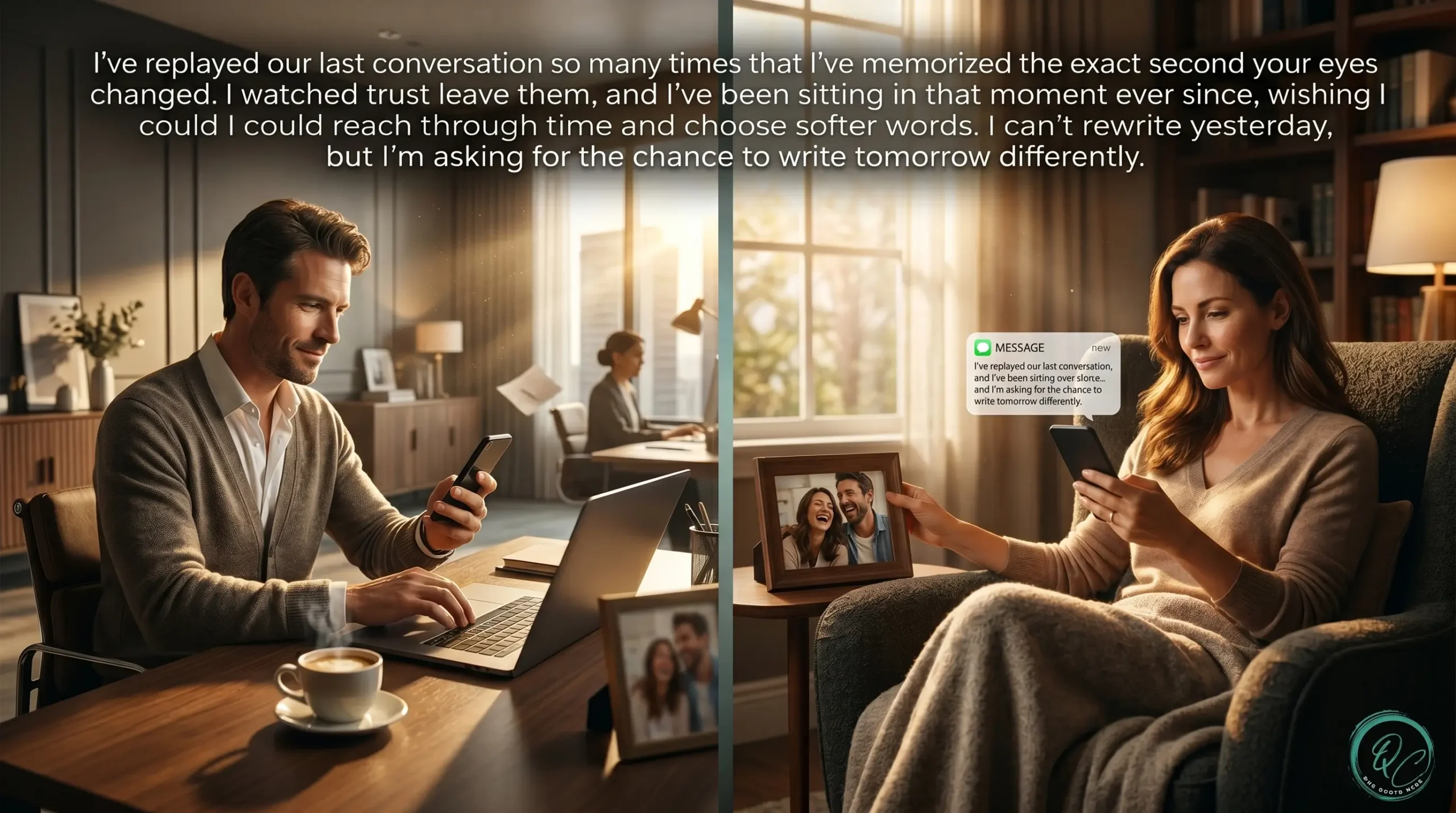
- I’ve replayed our last conversation so many times that I’ve memorized the exact second your eyes changed. I watched trust leave them, and I’ve been sitting in that moment ever since, wishing I could reach through time and choose softer words. I can’t rewrite yesterday, but I’m asking for the chance to write tomorrow differently.
How does this message endorse romance for forgiveness? It shows you were paying attention to her, not just your own feelings, which makes the romance feel observant rather than performative. - This isn’t a message to convince you I’m right—I wasn’t. This is a message to tell you I’ve been wrong in ways I’m still discovering, and each new understanding feels like another door opening toward the man I should have been for you all along. I want to walk through every single one.
How does this message endorse romance for forgiveness? It turns the apology into a journey of self-discovery inspired by her, making her the muse of your growth rather than a judge. - You should know that I’ve made a list—not of your faults, but of the moments I failed to cherish you properly. The list is long, and reading it back broke something necessary in me. I don’t want to be the man on that list anymore. I want to be the one you’d write about with a smile.
How does this message endorse romance for forgiveness? The tangible act of self-reflection demonstrates that her happiness matters enough to you to do painful internal work. - There’s a version of your laugh that only exists when you feel completely safe with someone. I was the thief of that laugh the other night, and I’ve been haunted by the silence I caused. Let me earn back the sound no one else in the world can make but you.
How does this message endorse romance for forgiveness? It elevates something uniquely hers—her laugh—and frames its return as a romantic quest rather than an obligation. - I told you I loved you a hundred times before the argument, but love isn’t measured in peaceful declarations. It’s measured in how quickly I choose your heart over my pride when things get hard. I chose poorly. But my next choice, and the one after that, and every one that follows—they’re all being made with you in mind.
How does this message endorse romance for forgiveness? It redefines love as a series of active choices, making the apology feel like a renewed commitment rather than empty words. - Remember how we used to talk about building a life together? I was so focused on the house and the plans that I forgot the foundation is made of moments like this—where I either choose us or I choose my ego. I’m choosing us. Let me prove that the blueprint of my heart still has your name on every room.
How does this message endorse romance for forgiveness? It connects the apology to your shared dreams, making forgiveness feel like protecting a future rather than erasing a past. - I keep looking at your side of the bed, and it’s not the emptiness that bothers me most—it’s knowing I’m the reason you needed space from a place that should be your sanctuary. I want to make our love feel like home again, not a place you need to escape from.
How does this message endorse romance for forgiveness? It uses intimate, domestic imagery to remind her of the closeness you share and the safety you want to restore. - I won’t hide behind “I didn’t mean it” because the words left my mouth and landed in your heart, and intention doesn’t erase impact. What I do mean, with every fiber of who I am, is that you deserve softness from me—always—and I’m ready to spend however long it takes relearning how to give it.
How does this message endorse romance for forgiveness? It sidesteps a common empty excuse and replaces it with accountability wrapped in tenderness. - If you give me another chance, I won’t treat it like a reset button. I’ll treat it like a sacred garden that nearly died in a storm I created. I’ll water it with patience, shield it from my worst impulses, and never again take for granted the blooms you chose to grow with me.
How does this message endorse romance for forgiveness? The metaphor transforms forgiveness into something precious you’re entrusted with, not something you’re owed. - I know “sorry” is a small word for a big wound. So let me expand it with the only thing that gives it meaning: changed behavior. I’m not asking you to believe my words today. I’m asking you to watch my actions tomorrow, and the day after, and the day after that, until the man you see matches the apology I’m offering now.
How does this message endorse romance for forgiveness? It shifts the currency of romance from verbal declarations to observable change, which is the most credible form of love. - You’ve always been the one who sees the best in people. I hate that I gave you reasons to stop seeing it in me. But if there’s even a flicker of that vision left—the one where I’m worthy of your time and your trust—I’ll spend my life becoming the man you always believed I could be.
How does this message endorse romance for forgiveness? It honors her character while humbling yourself, creating a dynamic where forgiveness becomes a shared act of faith. - The distance between us right now isn’t measured in miles or even in days. It’s measured in the moments where you’d normally reach for my hand and hesitate. I’ll wait through every hesitation, every uncertain glance, until the muscle memory of our love overpowers the memory of my mistake.
How does this message endorse romance for forgiveness? It acknowledges the physical toll of conflict while pledging patience, which is deeply romantic in its selflessness. - I don’t want your forgiveness because I need relief from my guilt. I want it because the thought of being the one who dimmed your light is unbearable to me. You shine in ways you don’t even notice, and I will never again be the cloud that blocks your sun.
How does this message endorse romance for forgiveness? It centers her radiance rather than your comfort, which reframes the entire apology as an act of devotion. - Let me be the one who restores what I broke. Not with grand gestures that fade, but with small, consistent proof that you’re the most important person in my world. A coffee made without asking. A patient response where I used to snap. A thousand tiny apologies lived out loud.
How does this message endorse romance for forgiveness? It grounds romance in everyday actions, making forgiveness accessible through realistic, sustainable love. - I’m not standing here asking for the old us back. I’m asking for a new chapter—one where I’ve finally learned that loving you means listening harder than I speak, holding gentler than I grip, and choosing your peace over my need to win. I’m ready to write it if you’re willing to turn the page.
How does this message endorse romance for forgiveness? It positions forgiveness as co-creation of something better rather than a reluctant return to the past.
4. Best Heart-Melting Apology Messages to Your Girlfriend

A heart never melts only with the perfect words, but with honest emotions. The following messages will melt the deepest frost between you and your girlfriend.
- I’ve been carrying around a conversation I owe you, and every hour I wait, it gets heavier. So here it is, without armor: I hurt you, and knowing that has rearranged something inside me. You’re not just someone I love—you’re someone I deeply respect, and I disrespected that bond. I’m laying my ego down right here, right now, and asking you to see me clearly, maybe for the first time.
How did this melt her heart? It demonstrates emotional weight and urgency without pushing her to respond, allowing her to witness a genuine internal transformation. - You know that feeling when a song comes on, and suddenly you’re right back in a memory? I had one of those moments today, and the memory was you laughing—carefree, unguarded, completely at home with me. Then I realized I’ve made that laugh harder to find lately. I want to bring it back, not because I miss the sound, but because you deserve to live in whatever frequency makes it come easy.How did this melt her heart? It ties the apology to a specific, cherished memory, proving you treasure her joy above your comfort.
- I’ve noticed something about you that I never told you: when you’re truly happy, you hum without realizing it. I haven’t heard that hum since we argued, and its absence has become the loudest reminder of what my carelessness cost. I’m not just sorry for the fight—I’m sorry I muted a song only you can sing.
How did this melt her heart? Revealing a detail she didn’t know you noticed makes her feel seen in a profoundly intimate way. - There’s a difference between hearing someone and listening to them. I heard your words during the argument, but I wasn’t listening to your heart. I was reloading my next point while you were bleeding the last one. That stops today. I’m handing you the space to speak without my interruption, without my defense—just my attention, fully and finally yours.
How did this melt her heart? Confessing a flaw this honestly and offering tangible change is disarming and emotionally generous. - If you could see inside my head right now, you’d find a messy room where pride used to sit neatly on a shelf. You knocked it over—not with anger, but with the quiet grace you showed even when I didn’t deserve it. You handled me better in my worst moment than I handled you. I’ve learned something about strength from watching you, and I’m sorry I had to learn it this way.
How did this melt her heart? It admires her character mid-apology, which transforms the message from groveling into genuine admiration mixed with remorse. - I used to think love meant never having to say you’re sorry. I was wrong. Love means saying it thoroughly, specifically, and without a safety net. It means risking the possibility that your apology might be rejected and offering it anyway, because her peace means more than your protection. So here I am, unguarded. Let this be my tuition paid for a lesson long overdue.
How did this melt her heart? It reframes apology as an act of courage and devotion, which elevates the entire exchange. - I keep writing and deleting, writing and deleting, because nothing feels enough. Then I realized: that’s the point. When you love someone the way I love you, there are no perfect words for wounding them—only honest ones. So here’s an honest one: I’m wounded too, not by you, but by the version of me that forgot how to be gentle with the best thing in my life.
How did this melt her heart? The vulnerability of admitting you struggled to write the message feels authentic and unscripted. - Do you remember our first fight? Neither do I, really. But I remember the first time I saw you cry because of me, and something cracked open that I didn’t know needed breaking. Every argument since has been a chance to either widen that crack into understanding or seal it shut with stubbornness. I sealed it this time. Let me pry it open again, gently, and let some light in.
How did this melt her heart? It acknowledges a pattern without making excuses, using shared history to frame growth as a mutual journey. - You’re not asking for a perfect boyfriend—you’re asking for a present one. One who stays in the hard conversations instead of escaping into his phone or his silence. I was absent when you needed my presence. That changes now. I’m not just back in the room; I’m back in the moment with you, and I’m not leaving until we find our way through this together.
How did this melt her heart? It identifies a common relationship wound—emotional absence—and promises specific, meaningful change. - I looked through our photos, and I noticed something: in every single one where I’m looking at you, I look like the luckiest person alive. The problem is, I haven’t looked at you that way lately—not because you changed, but because I got lazy in my seeing. I stopped noticing the details that made me fall for you. I’m noticing again. I’m looking again. You’re still the most beautiful thing in any room.
How did this melt her heart? It admits to taking her for granted while actively rekindling the awe she deserves. - There’s a particular cruelty in making the person you love feel alone. I didn’t hit you, I didn’t leave you—but I left you standing by yourself in a moment where you should have had an ally. I was your opponent when I should have been your partner. That’s a betrayal of our arrangement, and I’m here to renegotiate the terms in your favor.
How did this melt her heart? It names subtle emotional abandonment out loud, which validates feelings she may have struggled to articulate. - I’m not going to buy your forgiveness with flowers that wilt in three days. I’m going to earn it with consistency that lasts decades. No grand gestures, no performative romance—just the slow, steady work of becoming someone whose actions make his apologies rare and his love obvious. That’s my promise. Measurable. Observable. True.
How did this melt her heart? It rejects superficial romance in favor of profound reliability, which is ultimately far more romantic to a woman seeking security. - If someone asked me what I love about you, I could talk for an hour without repeating myself. If they asked me what I did to hurt you recently, I could talk for another hour without excusing myself. I’m holding both truths right now: my love for you is vast, and my failure was real. They coexist. The goal isn’t to erase one—it’s to let the love grow larger than the mistake.
How did this melt her heart? It holds complexity beautifully, neither minimizing the love nor the hurt, which feels mature and safe. - You deserve an apology that doesn’t make you responsible for my feelings. So I won’t tell you how miserable I’ve been or how I can’t sleep—that’s my weight to carry. I’ll just say you deserved better, and I’m ready to be better. No guilt trips dressed up as remorse. Just clean, simple accountability wrapped in love.
How did this melt her heart? Refusing to manipulate her sympathy while still expressing genuine sorrow is rare and deeply moving. - I don’t know how long it takes for trust to return after it’s been cracked. Days? Months? Maybe longer. What I do know is I’m not putting a deadline on your healing, and I’m not going anywhere while you heal. I’ll be here, showing up quietly, proving through consistency that the crack was an event, not a pattern. You set the pace. I’ll match it without complaint.
How did this melt her heart? Removing time pressure from forgiveness is the ultimate act of respect, and it creates safety for her to feel natural.
5. Cute Sorry Message for Girlfriend
Cute apologies do not mean being funny and ignorant. It means you still mean every word, making her smile. The following messages have a sweet spot between accountability and charm.
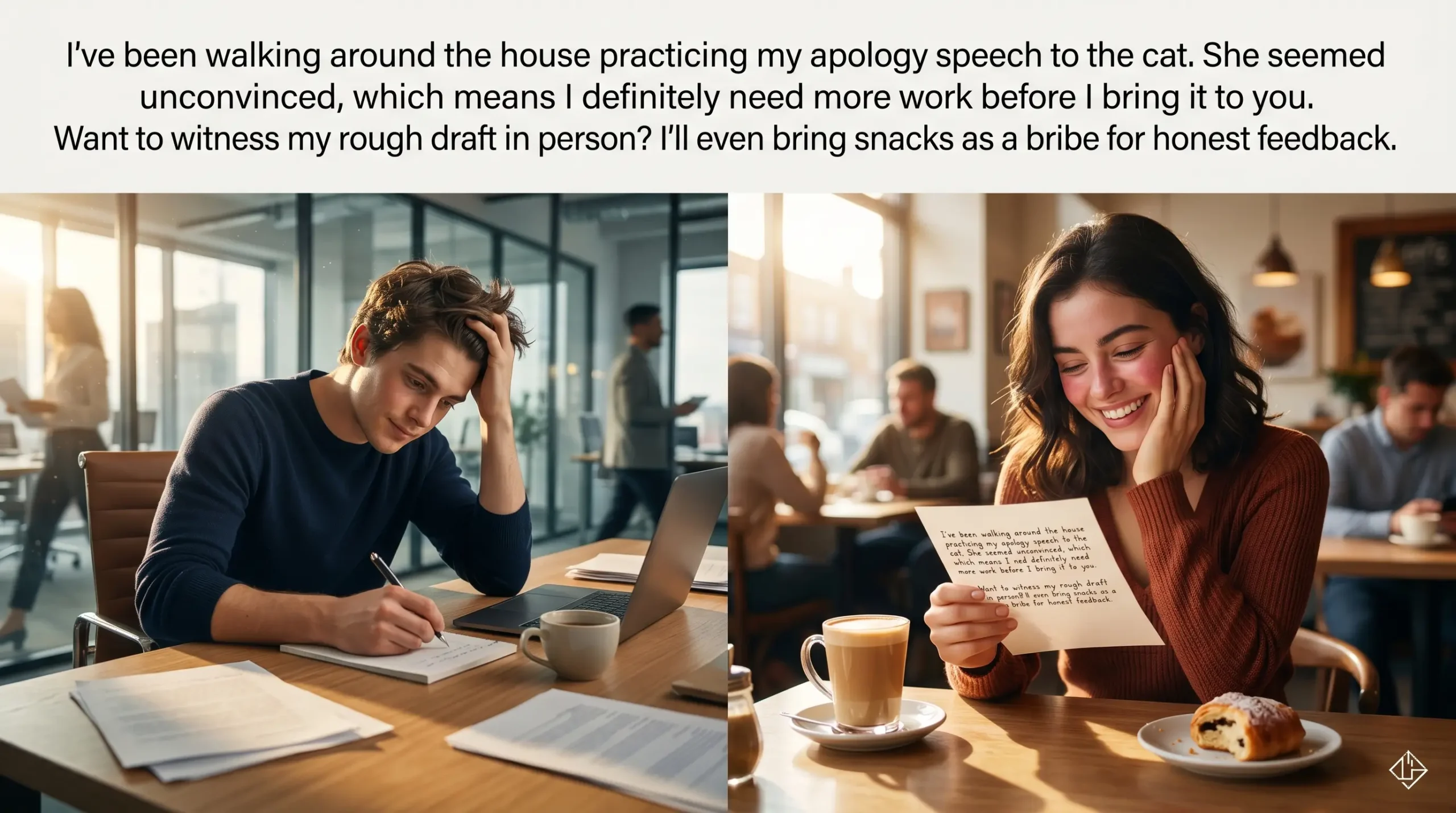
- I’ve been walking around the house practicing my apology speech to the cat. She seemed unconvinced, which means I definitely need more work before I bring it to you. Want to witness my rough draft in person? I’ll even bring snacks as a bribe for honest feedback.
How is this cute? It uses self-deprecating humor and an absurd image to disarm tension while showing you’ve been genuinely thinking about how to make things right. - I tried to make your favorite coffee this morning out of habit, and then remembered you weren’t here. So I drank it myself, and it tasted like regret with a hint of almond milk. Come home soon—the coffee is terrible without you, and so is everything else.
How is this cute? It anchors the apology in a small, relatable domestic ritual, making the absence feel tangible and the longing sweet. - Remember when you said I should think before I speak? Well, I finally tried it, and you were absolutely right. It only took me making a complete mess of things to figure it out. Consider this my official enrollment in the school of ‘She Deserves Better,’ with you as headmistress.
How is this cute? It playfully acknowledges her wisdom while exaggerating your own foolishness, which makes the apology feel lighthearted but genuine. - I made a list of all the things I love about you. It’s currently three pages long. Then I made a list of reasons why I acted like a complete potato. That list is blank because there’s no good reason. You win by default, and also by actually being wonderful. Sorry for the potato behavior.
How is this cute? Using silly language like “complete potato” injects humor into accountability, making the message impossible to read without a slight smile. - You know how in cartoons, a character gets hit on the head and little birds circle them? That’s been me since our argument. Except instead of birds, it’s little versions of you going, “Really, dude?” Consider me sufficiently pecked back to my senses.
How is this cute? The cartoon imagery is playful and visual, softening the apology while still conveying that you’ve been metaphorically knocked into awareness. - I bought your favorite candy bar to say sorry, but then I stress-ate it. So I bought another one. Also stress that one. I now have six candy bars and a very clear understanding that my apology needs to be in person, with you holding the snacks before I inhale them. Please save me from this cycle.
How is this cute? The escalating candy bar situation is absurdly relatable and shows you tried multiple times in a funny, imperfect way. - Update on my mood since we argued: everything feels slightly off, like when you put your shirt on backward and can’t figure out why the world seems wrong. You’re the tag that goes in the back, and I’ve been walking around with it choking me. Fix my outfit? Also, fix us?
How is this cute? The clothing metaphor is endearingly clumsy, comparing her essential role in your life to a simple, everyday thing everyone understands. - My brain has been replaying our argument on a loop like a broken playlist. I’d like to submit a request for a new track: “I Was a Fool (Please Forgive Me) – Extended Dance Remix.” I’ll even do the choreography if it makes you laugh. The moves are terrible, but so were my words.
How is this cute? Offering to dance badly to a made-up apology song is so ridiculous that it breaks through tension with sheer creative silliness. - If being right were a sport, I’d be in last place with a participation ribbon, and honestly, I’m fine with that. I’d rather have you happy and me wrong than me right and you hurting. So here’s my ribbon, here’s my apology, and here’s my promise to stop competing in a game I never want to win.
How is this cute? The sports metaphor framed as intentional losing reframes surrender as victory, with the “participation ribbon” adding a playful visual. - I accidentally used your toothbrush this morning. I think the universe was trying to tell me something about how tangled up I am without you. The new toothbrush is on the counter. New apology is in this message. Old idiot is currently typing and hoping you’ll forgive both infractions.
How is this cute? Combining a genuine minor mishap with the apology creates a “real life” feeling—messy, unplanned, and authentically human. - You’re the marshmallow in my hot chocolate, and right now my drink is just… aggressively warm milk. Come back and make everything sweeter. I promise to stop boiling over and saying things that scald. Temperature check: I’m ready to cool down and cuddle up.
How is this cute? The hot chocolate metaphor is cozy and sweet, translating her importance into comfort-food language that feels like a warm hug. - I’ve been practicing my puppy-dog eyes in the mirror for twenty minutes. Results are mixed—mostly I just look like I need eyedrops. But the intention is there, and the intention is: I miss you, I’m sorry, and I’ll probably look ridiculous when you finally see me, which is exactly what I deserve.
How is this cute? Admitting you practiced facial expressions and failed is vulnerable and funny, showing effort without taking yourself too seriously. - Scientists have proven that saying sorry is good for your health. I haven’t actually checked, but I’m choosing to believe it because I’ve said sorry to your photo, your pillow, and your favorite mug. All of them stared back silently. None of them is you. Please help me break this streak.
How is this cute? Apologizing to inanimate objects while they “ignore” you creates a silly, cinematic image that hints at genuine loneliness without being heavy. - Remember when I said I’m always right? No? Good, because I’m hoping you also forgot the dumb thing I actually said. Let’s make a deal: I’ll work on my mouth, you bring back your smile, and together we’ll pretend I never turned into a temporary gremlin. Do we have an accord?
How is this cute? Calling yourself a “temporary gremlin” is playful and self-aware, turning the argument into a minor blip rather than a defining event. - I’m currently charging my phone, clearing my schedule, and preparing my best “you were right, a nd I was a cloud of confusion” speech. Expect dramatic hand gestures, possibly a white flag, and definitely me tripping over my words because you still make me nervous in the best way. That’s today’s agenda. You in?
How is this cute? Building playful anticipation for an in-person apology with props and theatrics turns reconciliation into something she can actually look forward to.
6. Creative and Thoughtful Sorry Messages for Girlfriend

Creativity in an apology does not mean to repeat the same mistake. But it is about a new doorway to start when all are closed. The following messages show the realisation of the time spent with her.
- I’ve been thinking about what I’d say if I had sixty seconds with you and no interruptions. Here it is: I mapped out our argument like a road trip where I took every wrong turn possible, ignored your perfectly good directions, and drove us straight into a ditch. You were right about the route the whole time. I’m handing you the keys now.
What’s creative and thoughtful? Framing the argument as a road trip with her as the better navigator is an unexpected metaphor that concedes fault while giving her control of the future journey. - I owe you not just an apology but a revised version of myself—one with footnotes explaining exactly where the previous edition failed you. Publication date: today. Author’s note: You deserved better. Future revisions: pending your input, always.
What’s creative and thoughtful? Turning yourself into a book she can edit honors her intelligence and frames personal growth as a collaborative, ongoing process she leads. - If our love were a playlist, I just dropped a terrible track in the middle of it—something off-key, way too loud, and completely ruining the vibe. Permission to delete that song? I’m already composing a much better one, title: “She Was Patient When I Was Impossible.” Feature artist: you, always.
What’s creative and thoughtful? The playlist metaphor translates the argument into a shared cultural language while positioning her as the featured artist your life revolves around. - If our love were a playlist, I just dropped a terrible track in the middle of it—something off-key, way too loud, and completely ruining the vibe. Permission to delete that song? I’m already composing a much better one, title: “She Was Patient When I Was Impossible.” Feature artist: you, always.
What’s creative and thoughtful? The playlist metaphor translates the argument into a shared cultural language while positioning her as the featured artist your life revolves around. - I gathered up every sharp word I threw at you and laid them out on the table. Looked at them from every angle. None of them belonged in a conversation with someone I love. I’m not asking you to sweep them away—I’m asking you to watch me throw them out myself, one by one, naming each as I let it go.
What’s creative and thoughtful? The physical imagery of examining and discarding each hurtful word individually shows methodical remorse rather than a blanket apology. - There are languages I don’t speak, but I’ve been trying to learn the one that matters most: the language of your hurt. The syllables are in the way you went quiet. The grammar is in the space you’ve been taking. I’m not fluent yet, but I’m studying. Consider this my first complete sentence.
What’s creative and thoughtful? Treating her emotional expression as a language you must learn reframes listening as an act of cultural respect and dedicated effort. - I replayed our argument and muted my own voice. For the first time, I only heard yours—the cracks in it, the pauses, the words I steamrolled over. Without my noise in the way, I finally understood what you were actually saying. I’m sorry it took muting myself to amplify you. Volume adjusted permanently.
What’s creative and thoughtful? The audio mixing concept physically represents the practice of shutting up and listening, with a powerful final line that promises lasting change. - I’ve been leaving spaces for you in everything I do today—extra room on the couch, your side of the bed untouched, the last piece of toast uneaten. These tiny vacancies are my way of saying I’m keeping the architecture of us intact while you decide when you’re ready to occupy it again.What’s creative and thoughtful? Creating physical “spaces” as symbols of emotional openness turns absence into a quiet, ongoing invitation rather than a demand.
- If I could send you a care package for your heart right now, it would contain: one genuine apology, sealed and dated; a memory of us laughing, gently folded; my ego, finally deflated and packed flat; and a handwritten note explaining that everything inside was yours to begin with. Delivery method: however long you need.
What’s creative and thoughtful? Transforming abstract remorse into a tangible care package makes the apology feel concrete and curated just for her. - I’ve been writing and rewriting this message so many times that my phone probably thinks I’m drafting a novel. The working title is “How I Messed Up and What I’m Doing About It.” Chapter one: I stopped defending myself. Chapter two: I started truly hearing you. The rest of the chapters are yours to title.
What’s creative and thoughtful? Framing the apology as a book she can co-author shows ongoing commitment and gives her creative ownership over the resolution. - Remember when we tried assembling that furniture with instructions in a language neither of us understood? We still figured it out because we were patient with each other. I forgot that patience somewhere along the way, and I’m retracing my steps to find it. Found it. It was buried under my pride. Want to build something again?
What’s creative and thoughtful? A shared memory becomes a metaphor for your current situation, reminding her you’ve overcome confusion together before and can again. - I borrowed a page from your playbook today: I noticed things. The way sunlight hits the empty chair where you usually sit. The quiet of no one laughing at the show we watch together. The cold coffee because no one reminded me to drink it while it was hot. You’re woven into everything. The fabric doesn’t work without you.
What’s creative and thoughtful? Actively noticing and reporting the specific ways her absence is felt demonstrates her value without making her responsible for your pain. - I’ve been thinking about trust like a Polaroid photo. You handed me a clear image, and I shook it too hard before it developed. Now it’s blurry. I can’t undo the shaking, but I can sit here quietly, holding the next photo completely still, letting it develop at your speed, never grabbing it from your hands again.
What’s creative and thoughtful? The polaroid metaphor visually explains how impatience damages trust and what patient care looks like going forward. - I’m not going to bury my apology in a paragraph of excuses. Instead, I’m sending you a single, clean sentence surrounded by silence so you can actually hear it: I was careless with your heart, and I will carry that knowledge carefully from now on. The silence around these words is yours to fill or leave empty.
What’s creative and thoughtful? Deliberately creating silence around the core apology gives her space to process without crowding, showing restraint as a form of respect. - I tried to write this apology as a text, then as a letter, then as a voice note. None of them held enough dimension. So I’m sending it as a promise instead—a living, breathing thing that continues to exist even after you read it. Check on it tomorrow. It’ll still be here. Check next month. Still here. That’s the whole message.
What’s creative and thoughtful? Turning the apology into a “living promise” that can be revisited removes the pressure of a one-time exchange and builds long-term accountability. - You once told me you measure love in the small things. So here are my small things: I noticed your favorite mug was dusty, so I washed it. I remembered you hate it when I leave dishes in the sink, so they’re done. I’m not saying this to earn points—I’m saying it because your small things matter to me, and I finally understand they’re not small at all.
What’s creative and thoughtful? Using her own philosophy about love to structure the apology shows you’ve been listening all along and acting on what you heard.
7. Long and Detailed Sorry Messages for Girlfriend

A short apology can give you a start, but a detailed one can make you understand everything. When you take time to understand, you do not say sorry only, but you show that her healing matters more than your comfort.
- I’ve started this message seventeen times. Each version felt incomplete, like I was apologizing for the weather instead of the storm I actually caused. So let me be specific: I raised my voice when I should have lowered my defenses. I chose sharp words when soft ones were available. I made you the target of frustration that had nothing to do with you and everything to do with my inability to process my own stress. You didn’t deserve to stand in that line of fire. You deserved a partner who could say, “I’m struggling, and I need a minute,” instead of turning the struggle into a weapon pointed at you. I’m learning that sentence now. I’m practicing it in the mirror like a student learning a new language. The next time life pushes me, I’ll speak that instead of the poison I spat before.
What does this long detail want to say? It wants to demonstrate that you’ve done the painful work of tracing your behavior back to its root cause rather than offering a vague, dismissive summary. - I keep thinking about the moment right after I said what I said—the way your face flickered, then went still. That stillness is what haunts me. Not your anger, not your tears, but that brief, terrible calm that washed over your features when you realized I had crossed a line you never thought I’d approach. I watched you decide, in real time, that I wasn’t safe in that moment. That’s the image I can’t shake. I took safety from you—the one thing I promised to provide. No grand gesture restores that. Only time, consistency, and a complete restructuring of how I handle conflict. I’m restructuring. Starting with this admission: you were not overreacting. You were reacting to something real, something I did, and minimizing it would be a second injury. I refuse to injure you twice.
What does this long detail want to say? It wants to honor the precise moment the damage occurred, validating her reaction as proportionate and her pain as visible and real. - Let me walk you through what should have happened, because I’ve replayed it enough times to know. You brought me a concern—something that was bothering you, something you trusted me enough to share. Instead of receiving it as valuable information about the person I love, I received it as an attack. I armored up. I got defensive. I turned a conversation that could have brought us closer into a courtroom where I appointed myself both defendant and judge. You didn’t come to argue; you came to be heard. I took that opportunity and crushed it under the weight of my ego. From now on, when you bring me something heavy, I’ll hold it with you, not throw it back at you. That’s the partner you signed up for. That’s the partner I’m becoming.
What does this long detail want to say? It wants to reconstruct the alternative scenario, proving you now understand exactly where you diverged from being a good partner and how you’ll return to that path. - There’s something uncomfortable I need to admit, and I’m going to say it without flinching: part of me knew I was wrong while I was still arguing. I felt the wrongness sitting in my stomach like a stone, and I kept talking anyway. Momentum carried me. Pride carried me. The need to “win” carried me. And the whole time, a quieter voice was saying, “Stop. Look at her. She’s hurting. This isn’t worth it.” I ignored that voice. I’m telling you about it now because ignoring it was the original sin of that night—before the words, before the tone, before everything else. I had a chance to pump the brakes and chose the gas. That choice will not happen again. The quieter voice has been promoted. It’s the loudest one now.
What does this long detail want to say? It wants to confess the internal battle you lost, making your apology feel like a genuine apology rather than a public relations statement. - I need to talk about the aftermath—the part where you went quiet, and I didn’t follow. You withdrew, and instead of gently knocking on the door you closed, I waited outside like a stranger, pretending I didn’t know exactly why you’d locked it. That waiting wasn’t patience; it was cowardice dressed up as giving you space. Real love would have checked in. Real love would have said, “I know you’re hurting, and I’m here whenever you’re ready, but I’m not going anywhere.” I went somewhere. I went into my own head, nursing my own guilt, making this about my feelings instead of yours. I’m done making amends from a distance. I’m here now, close enough to see the individual threads of what I unraveled.
What does this long detail want to say? It wants to examine the often-ignored post-argument phase, holding yourself accountable for emotional absence even after the shouting ended. - You’ve probably been replaying my words on a loop, dissecting them, trying to find the truth inside the hurt. I’ve been doing the same, and here’s what I found: none of what I said was actually about you. It was about my exhaustion, my insecurity, my inability to sit with discomfort without throwing it onto someone else. You were just the nearest target. That’s a terrible thing to realize about yourself—that you used the person you love most as a punching bag for problems she didn’t create. It’s even worse to admit it out loud. But here it is, admitted, written in permanent ink: it wasn’t about you. You were collateral damage in a war I was fighting entirely inside my own head. I’m ending that war. You’re not the battlefield anymore.
What does this long detail want to say? It wants to free her from the burden of your internal chaos, clearly separating her actions from your disproportionate reaction. - I want to discuss the specific words I used, because a blanket apology for “what I said” lets me avoid accountability for the actual damage. I told you that you were being dramatic. Those three words didn’t just dismiss your feelings; they told you that your internal experience was exaggerated, invalid, and not worth taking seriously. That’s gaslighting, however unintentional. The truth is, you were having an appropriate emotional response to something hurtful, and I called it an overreaction because it was easier than facing what I’d done. I won’t use language that makes you question your own reality. Your feelings are always, always valid—especially when they’re inconvenient for me.
What does this long detail want to say? It wants to name specific harmful phrases and dismantle them, showing that the apology extends to the granular level of verbal accountability. - There’s a version of this apology that I’ve heard men give my whole life—the one where they say just enough to get the silence to end, then slowly revert to the same behavior, then apologize again, creating a cycle that exhausts the woman into either leaving or accepting perpetual disappointment. I am actively, consciously refusing to be that man. This apology is not a pause between mistakes. It’s a full stop. I’m not interested in performing remorse for a week and then getting comfortable again. I’m interested in rewiring something fundamental. If that takes a month of proving, or a year, or a lifetime, then that’s what I’m signing up for. I’m not writing this to get past the argument. I’m writing this so there is no next argument that looks anything like this one.
What does this long detail want to say? It wants to distinguish itself from the cultural pattern of hollow male apologies, promising not a reset but a transformation. - I’ve been thinking about the version of you that existed before we met—the one who didn’t know me, didn’t love me, didn’t have to brace herself for my bad moods. That version of you laughed without reservation. She didn’t have a category in her brain labeled “things he might say when he’s upset.” I introduced that category. I built a small room of caution inside you where there used to be open space. You let me in, and I redecorated a corner with anxiety. I can’t demolish that room overnight, but I can commit to never adding another brick to it. And eventually, I hope that room becomes storage for something else—good memories, maybe, that crowd out the bad ones.
What does this long detail want to say? It wants to acknowledge the long-term psychological architecture of hurt and make a poetic commitment to remodeling what was damaged. - I want to apologize not just for the fight but for the hours before it—the tension I brought home, the short answers, the way I created an atmosphere where an explosion was inevitable. You didn’t walk into a calm house and start a fire. You walked into a room already filled with fumes. I’d been marinating in stress all day, and instead of communicating that, I let it build until the smallest spark from you set everything ablaze. Then I blamed you for the fire. That’s not fair. That’s not partnership. From now on, when I’m carrying gasoline, I’ll tell you before you strike a match. Better yet, I’ll learn to put the gasoline down long before I walk through our door.
What does this long detail want to say? It wants to trace the timeline back further than the argument itself, acknowledging the preconditions you created that made conflict inevitable. - You once told me that you feel things deeply and that it takes you longer to process emotional events than it takes me. I nodded, and I said I understood, but I didn’t act as I understood. I rushed you. I pushed for a resolution on my timeline. I treated your processing speed like a problem to solve rather than a fundamental part of who you are that deserves accommodation. That was ableist toward your emotional makeup, and it was cruel in ways I’m only now fully comprehending. Take all the time you need. I mean that literally—take it. I’m not timing you. I’m not tapping my watch. I’m learning to match your pace instead of demanding you match mine.
What does this long detail want to say? It wants to honor her unique emotional processing style as valid, apologizing not just for the fight but for a history of disregarding her needs. - The apology I owe you isn’t just about what I did—it’s about what I failed to do. I failed to protect you from the worst parts of myself. I failed to create an environment where you could bring me concerns without fear of retaliation. I failed to be the man you brag about to your friends, the one they’re all slightly jealous of because he treats you so well. Lately, if you talked about me honestly, the stories wouldn’t inspire jealousy; they’d inspire concern. I never want to be the reason your friends worry about you. I want to be the reason they believe good men still exist. I’ve fallen from that standard. I’m climbing back toward it, handhold by handhold, and I won’t stop until I’m recognizable again.
What does this long detail want to say? It wants to expand the scope of the apology to include failures of omission and the broader social context of your relationship’s reputation. - I keep remembering something you said to me months ago, during a completely different conversation. You said, “The way you handle my bad days tells me everything about whether this is real.” I handled your bad day—the one I caused—terribly. If that’s the measure you’re using, I just failed the most important test. But I’m asking for a retake. Not a free pass, not a grade boost out of pity—a retake where I’ve actually studied. I’ve been cramming. I’ve been learning. The next time you have a bad day, whether I’m the cause or not, I want my response to be the correct answer to the question you asked months ago, without even realizing you were asking it again.
What does this long detail want to say? It wants to connect the current apology to a past statement she made, proving long-term memory and deep listening. - I need to address the loneliness of being with someone who’s supposed to love you but is actively hurting you. It’s a specific, disorienting loneliness—you can reach out and touch the person, but they’re emotionally on another planet. I know you felt that. I could see it in the way you looked at me like I was a stranger wearing a familiar face. I hate that I made you feel alone in a relationship where you’re supposed to feel the opposite of alone. I hate that I made our home, our little sanctuary, feel like a place where you needed emotional armor. I’m putting down my weapons. I’m taking off my own armor. I’m standing here completely unarmed, completely exposed, completely sorry, asking you to feel safe enough to do the same.
What does this long detail want to say? It wants to name the specific pain of relational loneliness, a hurt that goes deeper than the argument content itself. - Finally, I want to talk about where we go from here. Not from a place of me making demands or setting timelines, but from a place of genuine curiosity about what you need. Do you need space? I’ll give it without making you feel guilty. Do you need more words? I have them. Do you need me to just sit quietly in the same room, proving through presence that I’m not leaving? I’ll sit for hours. Do you need me to go to therapy and work on whatever broken piece of me thinks it’s okay to speak to you the way I spoke? Already researching therapists. This isn’t a negotiation where I offer options until you pick one. This is an open field where you tell me what qualifies as repair, and I do it, whatever it is, no questions asked except “Is this helping?”
What does this long detail want to say? It wants to relinquish control of the reconciliation process entirely, placing the architecture of healing in her hands and your resources at her disposal.
8. Romantic and Loving Apologies for Girlfriend

A romantic and loving apology is not about a word, sorry, but it brings the warmth and tenderness she is missing. The following apologies are led by love, and they land softly on the heart.
- If I could gather every time you’ve looked at me with pure, unfiltered love and bottle that light, I’d hold it up right now and ask myself how I ever risked dimming it. You are the gentlest thing that has ever happened to my life, and I treated a moment that needed gentleness with something rougher. That won’t become our pattern. You’ll only know softness from me now, even when—especially when—we disagree.
What makes this loving and romantic? It frames her love as luminous and precious, then commits to matching that softness, turning the apology into a vow of tenderness. - Loving you has been the most natural thing I’ve ever done, which is why it terrifies me that I made it feel complicated the other night. You deserve effortless warmth, the kind that doesn’t get interrupted by ego or impatience. I’m returning to my most natural state—the version of me that finds it easy to be kind because the kindness is directed at you.
What makes this loving and romantic? It positions loving her as your default setting, suggesting the argument was an aberration from your true, love-filled self. - You walk into rooms and change their temperature. You walk into my life and change its meaning. So when I became a source of cold instead of warmth for you, I betrayed not just our relationship but the very purpose you’ve given my days. You make everything matter more, including this apology. I’m sorry with the full weight of someone who knows exactly what he almost lost.
What makes this loving and romantic? It elevates her influence on your entire existence, making the stakes of the apology feel cosmically significant. - I’ve kissed your forehead a thousand times, but I want the next one to carry an apology. I want you to feel, in that simple gesture, everything my words are struggling to say: that I will spend the rest of our relationship protecting your peace, that my lips will never again form words that wound you, that this forehead kiss is a seal on a new promise.
What makes this loving and romantic? It attaches meaning to a familiar intimate gesture, transforming it into a physical contract of changed behavior. - There’s a quiet courage in the way you love me—you keep showing up, keep softening, keep choosing us even when I make it difficult. I see that courage now with painful clarity, and I’m humbled by it. You’ve been brave with your heart. It’s my turn to be brave with my accountability. Here it is, laid at your feet, wrapped in the awe you inspire.
What makes this loving and romantic? It reframes her past patience as bravery and meets it with your own courage, creating mutual admiration within the apology. - I don’t just love you; I like you. I like the way your mind works, the way you explain things, the way you see the world. So when I dismissed what you were saying during our argument, I wasn’t just being a bad boyfriend—I was being a bad friend. And you deserve both. You deserve a lover who is also your greatest listener. I’m reclaiming that role, starting with these words.
What makes this loving and romantic? Distinguishing between loving and liking her adds a layer of friendship to the romance, which is deeply endearing and grounded. - If someone asked me to describe you in one word, I’d say “home.” And then I’d have to explain why I made home feel like a place you needed to leave. That contradiction breaks my heart, because I know what it took for you to trust someone enough to call them home in the first place. I’m rebuilding. Brick by brick. Word by word. Come see what I’ve done with the place.
What makes this loving and romantic? The “home” metaphor is intimate and universally understood, and the rebuilding imagery invites her back into a space you’ve improved. - I’ve been thinking about our first date—what I wore, what you ordered, the exact moment I knew you were different from everyone else. That memory is untouched by any argument we’ll ever have. It lives in a protected space where only good things exist. I want to fill more rooms in our shared history with memories like that. Fewer arguments, more first-date energy. I’m bringing that energy back.
What makes this loving and romantic? Returning to the origin story of your relationship reminds her of the foundation beneath the temporary damage. - The way you love people is extraordinary—not just me, but your friends, your family, strangers who need kindness. You pour yourself out constantly. The last thing I ever want to be is someone who takes from that cup without refilling it. I took it from it during our fight. Now I’m refilling it with patience, with listening, with the kind of love that replenishes rather than drains.
What makes this loving and romantic? It admires her general character, not just her role as your girlfriend, showing you see her fully as a human being. - I fell in love with the sound of your voice before I even fully understood why. So when my voice became louder than yours, I drowned out the very thing that drew me to you in the first place. That’s not just bad communication—that’s a betrayal of our origin story. Your voice is the melody in my life. I’m turning the volume down on myself so I can hear it clearly again.
What makes this loving and romantic? It traces love back to a sensory detail—her voice—and frames listening as an act of romantic devotion. - You have this incredible ability to make people feel seen. You notice when someone’s struggling, when they need a kind word, when they’re hiding behind a smile. Ironically, the one person you couldn’t see during our argument was yourself, because I was too busy being defensive to offer you the same care you give everyone else. Let me be your mirror. Let me see you the way you see the world.
What makes this loving and romantic? It describes a specific, admirable trait of hers and offers to extend it toward her, creating poetic reciprocity. - I was lying awake last night thinking about your hands—how they reach for mine under tables, how they fix my collar without me asking, how they’ve held me through hard days. I haven’t been holding those hands with enough care. From now on, every time I take your hand, it’ll be a silent renewal of this apology. Squeeze once if you forgive me. I’ll feel it even if you don’t squeeze yet.
What makes this loving and romantic? Focusing on a specific physical feature and attributing meaning to future touches turns the body into a site of ongoing reconciliation. - Our love isn’t fragile. It’s been tested by distance, stress, and now my own foolishness, and it’s still standing. But I don’t want a love that merely survives me—I want one that thrives because of me. I want to be the reason you feel stronger, not the reason you need strength. I’ve been the latter lately. Watch me become the former.
What makes this loving and romantic? It honors the resilience of the relationship while refusing to exploit it, reaching for flourishing rather than mere endurance. - Someday, when we’re old and gray and sitting on a porch somewhere, I want this argument to be a distant memory that we barely recall. I want the story of us to be overwhelmingly beautiful, with only a few chapters where I was an idiot. This is one of those chapters. But the book isn’t finished, and the author has learned something important about writing the rest of it with more care, more tenderness, and you as the central character always.
What makes this loving and romantic? The lifelong perspective frames the argument as a small blemish on a vast canvas of love, with the future still unwritten and full of possibility.
9. Apology Message To My Love For Hurting Her

When a person is hurt by someone she loves the most. The apology must carry the full weight of what you risked. The following messages will make her heart beat more, building a bridge back to her.
- My love, I’ve started this message so many times that my drafts folder looks like a graveyard of good intentions. But you don’t need my intentions—you needed my kindness, and I withheld it in a moment that called for generosity. You are the person I claim to treasure above all others, and I acted like you were an inconvenience. That disconnect between my words and my actions is something I can’t unsee now. I love you, and I’m ready to prove that love isn’t just a word I use when things are easy.
Why is this message for your love? It uses the direct address “my love” and frames the betrayal as a gap between claimed love and demonstrated love, which is intimate accountability only suited for a deep relationship. - To the woman who knows me better than anyone: you’ve seen me at my worst before, but this time I crossed a line that even your generous heart shouldn’t have to process. The fact that you’re still somewhere out there, possibly reading this, possibly not ready to—that fact alone tells me you’re still giving me more grace than I earned. I’m not squandering it this time. I love you with a clarity I lacked in that awful moment.
Why is this message for your love? It acknowledges her unique knowledge of you and her history of grace, referencing the deep archive of a committed relationship. - I called you my love this morning, out of habit, to an empty room. The words hung there without you to receive them, and I realized I’ve been saying “my love” without fully inhabiting what it means. It means you are the recipient of my best, not the target of my worst. It means I protect you, even from myself. It means when I fail at that, I don’t make excuses—I make amends. Here they are.
Why is this message for your love? It deconstructs a pet name you use and rebuilds it with meaning, making the apology about honoring the title she holds in your life. - I hurt you, and in doing so, I hurt myself—not because my pain matters equally, but because my well-being is tied up in yours. When you’re wounded, I’m walking around with an injury I inflicted on my own body. That’s what loving you has done to me: it’s fused your heart to mine so completely that harming you is self-harm. I finally understand that. The lesson came late, but it came.
Why is this message for your love? It expresses the profound interconnectedness of long-term love, where her pain becomes yours in a way that’s visceral rather than metaphorical. - My love, do you remember when we talked about what we needed from each other during hard times? You said you needed softness, and I nodded as I understood. I didn’t understand fully until I gave you the opposite and watched the consequences unfold. Now I understand in my bones. Softness isn’t optional—it’s the entire assignment. I’m turning in my corrected work. Grade me honestly.
Why is this message for your love? It references a private conversation only the two of you share, making the apology specific to your relationship’s history and her stated needs. - There’s a photo of us on my phone—you’re laughing at something I said, and I’m looking at you like you hung the moon. I stared at it for ten minutes today, and all I could think was: that man in the photo would be horrified by what I said to you. I want to be him again. Not the idealized version, but the real one who knew that your laughter was the most important sound in any room. I love you. I’m finding my way back to that man.
Why is this message for your love? It uses a tangible shared memory as a compass point for who you want to be for her, grounding the apology in your specific history together. - To my love, who has never deserved a single harsh syllable from me: I’ve been replaying the sound of my own voice and wincing. You’ve given me years of gentleness, of patience, of second and third chances. I repaid that with a moment of cruelty. The math is horrifying. I want to spend the rest of our relationship balancing the equation, not because you’re keeping score, but because I finally am.
Why is this message for your love? It calculates the emotional debt you owe her over the long arc of the relationship, acknowledging her sustained investment in you. - I love you—not the idea of you, not the comfort you provide, but the specific, irreplaceable human being who exists nowhere else in the universe. And I hurt that human being. Your rarity makes my failure enormous. There are billions of people on this planet, and exactly one of you. I was entrusted with that one, and I was careless. I won’t be careless with rare things anymore.
Why is this message for your love? It frames her as singular and precious, which is the essence of romantic love—seeing one person as irreplaceable among billions. - My love, I keep thinking about the trust you placed in me. You handed me your heart without a receipt, expecting I’d handle it with care. I fumbled it. I didn’t just drop it—I kicked it across the floor while you watched. The image makes me sick. But I’m picking it up now, dusting it off, and handing it back to you. Whether you trust me to hold it again is your decision. I’ll accept either answer with the humility I should have had from the start.
Why is this message for your love? It employs the classic “heart in hands” imagery but makes it painfully physical and self-indicting, which suits the gravity of hurting someone you’re supposed to protect. - You told me once that you felt safest with me. I’ve been thinking about that word—”safest.” Superlative. Above all others. I occupied the highest position of trust in your life, and I breached it. If I could rebuild that safety with my bare hands, brick by brick, I would start right now and not stop until you felt it again. Tell me where the first brick goes. I love you enough to do the manual labor of repair.
Why is this message for your love? It recalls a specific, meaningful word she used about you, honoring her voice while committing to the physical work of reconstruction. - To the love of my life, who didn’t sign up for any of this: you signed up for partnership, for romance, for someone who had your back. You didn’t sign up for a man who weaponizes your vulnerabilities when he’s stressed. I brought a version of myself into our home that violated the contract we never had to write down because we thought it was obvious. I’m rewriting it, in ink, on paper, so it’s never unwritten again. Clause one: She is sacred.
Why is this message for your love? It treats the relationship as a sacred contract and your violation as a breach of fundamental terms, which speaks to the seriousness of committed love. - 12. My love, I owe you an apology that doesn’t center on my feelings. So I’ll say this once and then focus on you: I’m devastated by my own actions, but that’s my burden. What matters is that you were hurt, you were disrespected, and you were made to feel small by the one person whose job it is to make you feel enormous. I failed at my job. I’m retraining. I’m relearning. You’re the curriculum.
Why is this message for your love? It consciously shifts focus from the apologizer’s guilt to the recipient’s pain, which is a mature love practice that prioritizes her experience. - I was supposed to be your soft landing, and I became the turbulence. That reversal is the greatest failure of my life—not because I’m dramatic, but because loving you is the most important thing I’ve ever done, and I did it poorly in a moment that mattered. I’m asking for the chance to be your soft landing again. Not tomorrow, not next week, but whenever you’re ready to land.
Why is this message for your love? The “soft landing” metaphor captures the protective function of love, and the apology promises restoration without demanding immediate return. - To my love: you’ve probably been wondering if I even understand what I did. I do. I understand it in the pit of my stomach, in the sleepless hours, in the way I reach for my phone to text you something mundane and then remember I don’t have that privilege right now. I understand it in the absence of you, who is the loudest teacher I’ve ever had. I love you, and I’m listening to the silence you left. It’s lecturing me.
Why is this message for your love? It describes the visceral, embodied experience of her absence, which is something only someone deeply in love would feel so physically. - I love you—and this time, I’m not saying it as a reflex or a comfort or a way to soften you. I’m saying it as a fact that exists independently of whether you forgive me. The sun is hot. The ocean is deep. I love you. These things remain true even when everything else is uncertain. Even if you’re not ready to hear it. Even if you never want to hear it again. I love you, and I’m sorry, and both of those statements will still be standing here, unchanged, whenever you’re ready to look at them.
Why is this message for your love? It declares love as an unconditional constant rather than a bargaining chip, which is the deepest form of romantic commitment—love without expectation of return.
Final Thoughts
An apology paragraph can erase what my actions did a week or months ago. Real healing is not about perfection but patience and willingness. You keep showing up long after the words.
Forgiveness arrives on its own schedule. Honesty paired with consistency softens the heart and heals the hurt. So, let empathy guide your next move and trust that care still exists.
FAQ’s: (Frequently Ask Questions)
-
How to say sorry and win her back?
Acknowledge the specific hurt you caused without deflection, give her space to process, and follow words with consistent changed behavior until trust naturally returns.
-
How to apologize to a girlfriend you hurt deeply?
Be fully present, validate her feelings without justifying your actions, take complete ownership, and demonstrate through patience that her healing matters more than your comfort.
-
How to write a heartfelt apology letter to win them back?
Open with direct accountability, describe the exact moment you realized the pain you caused, commit to specific changes, and release her from any obligation to respond.
-
What is the deepest apology?
One that expects nothing in return, names the wound precisely, carries no hidden justifications, and continues showing up quietly through actions long after the words fade.
-
How to beg your ex to come back after hurting them?
Replace begging with honest accountability, respect their timeline completely, demonstrate genuine transformation through sustained actions, and let them choose without pressure or manipulation.